You want a blender that can turn frozen fruit into silk, pulverise kale into something drinkable, and handle hot soup without the lid blowing off and redecorating your ceiling. High-speed blenders do all of this — but the price range runs from £50 to £600, and the difference between a bad blender and a good one is the difference between a smoothie and a lumpy punishment. After testing blenders daily for over a year, making everything from breakfast smoothies to nut butter to cauliflower soup, these are the ones worth buying.
In This Article
- Best Overall High-Speed Blender
- What Makes a Blender “High-Speed”
- Top High-Speed Blenders for 2026
- Vitamix vs Ninja: Which Should You Buy?
- What Can a High-Speed Blender Actually Do?
- Motor Power and Blade Design
- Jug Size and Material
- Noise Levels: The Elephant in the Room
- Cleaning and Maintenance
- Do You Actually Need a High-Speed Blender?
- Where to Buy in the UK
- Getting the Most from Your Blender
- Frequently Asked Questions
Best Overall High-Speed Blender
The Vitamix Explorian E310 is the blender I’d buy if I could only own one. At about £300-350, it’s not cheap — nobody pretends otherwise — but after 14 months of daily use, it still performs identically to the day it arrived. Frozen fruit, raw nuts, hot soup, ice — it handles everything without hesitation. The 10-year warranty tells you something about how confident Vitamix is in its own product.
If £300+ is too much (completely fair), the Ninja 2-in-1 Blender with Auto-iQ at about £80-100 is the best mid-range option. For pure budget, the Nutribullet 600 Series at around £40-50 handles personal smoothies brilliantly but struggles with larger batches.
What Makes a Blender “High-Speed”
A standard blender spins at about 10,000-15,000 RPM. A high-speed blender hits 25,000-30,000+ RPM. This sounds like marketing, but the practical difference is real:
Texture
High-speed blenders produce properly smooth results. No chunks of frozen banana, no stringy kale, no grainy nut milk. A standard blender gets you 80% of the way there. A high-speed blender gets you to 99%.
Speed
A high-speed blender makes a smoothie in 30-60 seconds. A standard blender takes 2-3 minutes for the same result, often requiring you to stop, scrape the sides, and restart.
Versatility
High-speed blenders can do things standard blenders can’t — make hot soup from raw ingredients (the friction heats the liquid), grind coffee beans, turn nuts into butter, crush ice to snow consistency, and blend fibrous vegetables into completely smooth purées.
Top High-Speed Blenders for 2026
Vitamix Explorian E310 — Best Premium
The E310 is the entry point into the Vitamix range, and it’s all most home cooks need. The 1.4-litre jug handles portions for 1-4 people, the variable speed dial gives precise control, and the aircraft-grade stainless steel blades are designed to never need replacing — they’re dull by design, relying on speed and power rather than sharpness.
- Motor: 1400W
- Jug capacity: 1.4 litres
- Speed settings: Variable dial (1-10) plus pulse
- Warranty: 10 years
- Price: About £300-350
- Buy from: Vitamix UK, John Lewis, Amazon UK, Lakeland
The build quality is noticeably superior to anything under £200. The base is heavy (it doesn’t walk across the counter), the jug locks securely, and the motor handles continuous blending without overheating. I’ve run ours for 6-minute soup cycles back-to-back and it hasn’t flinched.
Ninja 2-in-1 Blender with Auto-iQ — Best Mid-Range
Ninja’s Auto-iQ technology uses pre-programmed blending patterns — pulsing, pausing, and blending at different speeds automatically — to produce consistent results without you standing over it. At about £80-100, it’s a quarter of the Vitamix price and delivers 85% of the performance.
- Motor: 1200W
- Jug capacity: 2.1 litres (plus personal cup attachment)
- Speed settings: 3 manual speeds + Auto-iQ programmes
- Warranty: 2 years
- Price: About £80-100
- Buy from: Argos, Amazon UK, Currys, Ninja UK
The included personal cup attachment is a smart addition — blend your smoothie in the cup, twist on the drinking lid, and go. No jug to wash. The main jug’s stacked blade design handles frozen fruit and ice well, though it doesn’t achieve quite the silk-smooth texture of a Vitamix on fibrous greens.
Sage Super Q — Best for Serious Cooks
If you want Vitamix performance with more modern features, the Sage Super Q is the answer. It has preset programmes for smoothies, soup, frozen desserts, and more, plus a noise-suppression dome that makes it noticeably quieter than competitors. At about £400-450, it’s pricier than the Vitamix E310 but adds convenience features that justify the premium for some users.
- Motor: 1800W
- Jug capacity: 2 litres
- Speed settings: 12 speeds, 5 presets, manual override
- Warranty: 10 years (motor), 2 years (full product)
- Price: About £400-450
- Buy from: Sage direct, John Lewis, Lakeland
Nutribullet 600 Series — Best Budget
The original personal blender. At about £40-50, it’s not a high-speed blender in the traditional sense — the motor is modest and the jug is small — but for making individual smoothies, protein shakes, and baby food, it’s hard to beat for the price. Blend in the cup, twist, drink. No mess, minimal washing up.
- Motor: 600W
- Jug capacity: 680ml (personal cup)
- Speed settings: 1 speed (push and blend)
- Warranty: 1 year
- Price: About £40-50
- Buy from: Argos, Amazon UK, Currys
The limitation is obvious — you can’t make soup, you can’t blend for a family, and fibrous greens don’t always break down completely. But for a single person wanting a daily smoothie, it’s the right tool at the right price.
Kenwood kMix BLX750 — Best Looking
If aesthetics matter (and in an open-plan kitchen, they do), the Kenwood kMix is the most attractive blender in this roundup. Retro styling in several colours, a solid die-cast metal body, and enough power for most tasks. Not as raw as a Vitamix, but far more pleasant to leave on the counter.
- Motor: 800W
- Jug capacity: 1.6 litres
- Speed settings: 5 speeds + pulse
- Warranty: 2 years
- Price: About £90-120
- Buy from: John Lewis, Currys, Amazon UK
Vitamix vs Ninja: Which Should You Buy?
This is the question everyone asks. The short answer:
- Buy Vitamix if: You blend daily, you want one blender for life, you make hot soups, nut butters, and demanding recipes, and you can afford the upfront cost
- Buy Ninja if: You blend a few times a week, you want great results without the premium price, and the personal cup attachment appeals to your lifestyle
The Vitamix is objectively better at blending — smoother results, more durable motor, longer warranty. But the Ninja is 75% of the performance at 25% of the price. For most people, the Ninja is the smarter purchase.
What Can a High-Speed Blender Actually Do?
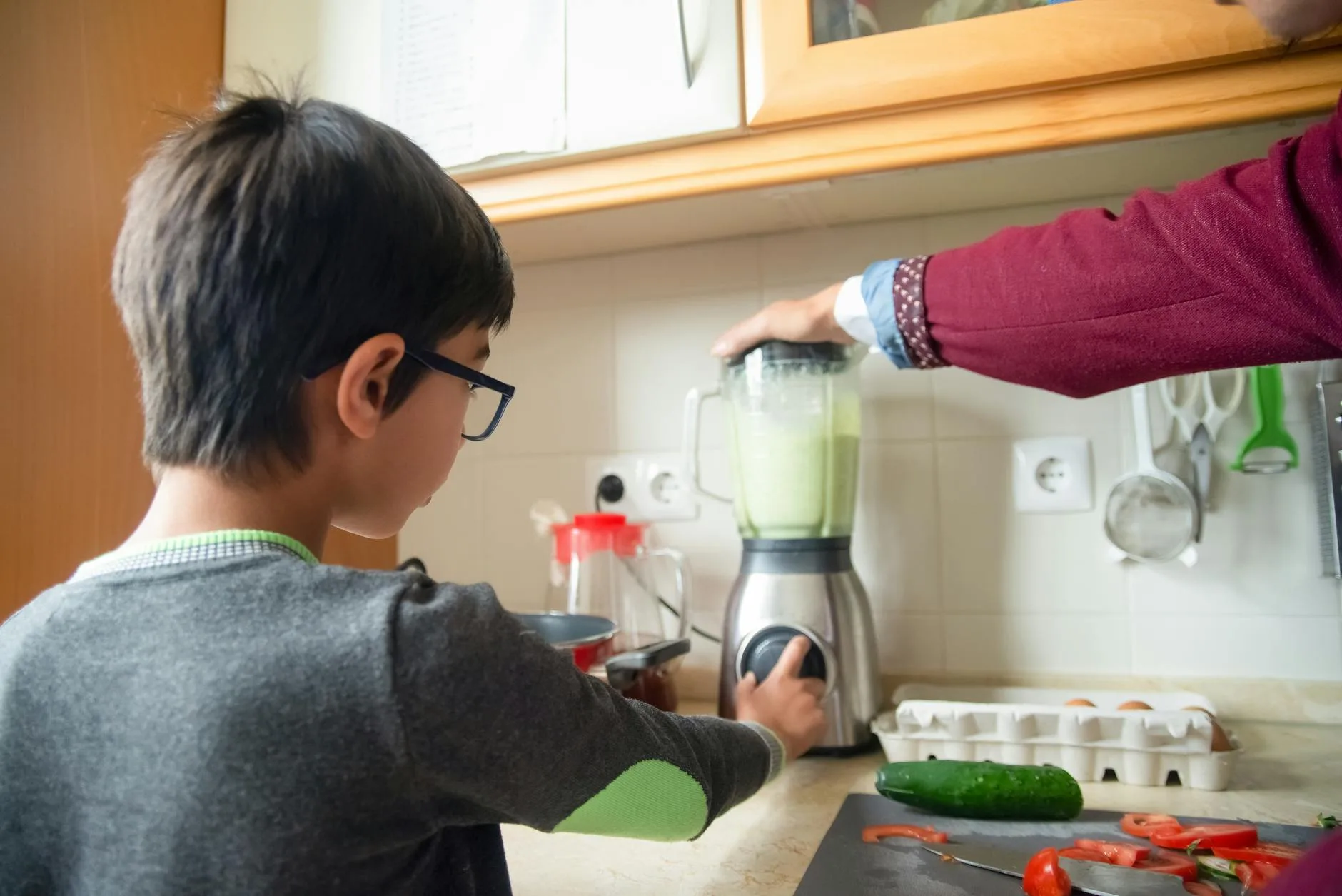
Beyond smoothies, a good high-speed blender handles:
- Hot soup — blend raw vegetables with hot stock for 5-6 minutes and the friction creates piping hot, smooth soup. No need to cook first
- Nut butter — almonds, cashews, peanuts. Takes 3-4 minutes of continuous blending
- Nut milk — blend soaked nuts with water, strain through a nut milk bag
- Frozen desserts — frozen bananas become soft-serve ice cream in 30 seconds
- Grinding — coffee beans, spices, oats into flour
- Baby food — steamed vegetables blended to perfect smoothness
- Sauces and dressings — hummus, pesto, vinaigrettes, curry pastes
- Pancake and waffle batter — throw everything in, blend for 10 seconds
The NHS recommends eating a balanced diet including fruits and vegetables. A blender that makes this easy — smoothies packed with spinach, berries, and seeds that taste good — removes one of the main barriers to healthy eating.
Motor Power and Blade Design
Wattage
Higher wattage generally means more blending power, but it’s not the whole story. A well-designed 1200W blender (like the Ninja) can outperform a poorly designed 1500W blender. For a detailed breakdown, our blender wattage guide covers exactly what the numbers mean.
- 600-800W — fine for smoothies and soft ingredients
- 1000-1400W — handles frozen fruit, ice, and most tasks
- 1400W+ — professional-grade, handles everything including nut butters and hot soups
Blade Design
Vitamix uses dull, aircraft-grade stainless steel blades that rely on speed to obliterate ingredients. Ninja uses stacked blade assemblies that chop at multiple heights. Both approaches work — Vitamix produces smoother results on fibrous ingredients, while Ninja handles chunky tasks (like ice crushing) more evenly.
Jug Size and Material
Size
- Personal (500-700ml) — Nutribullet-style cups for individual portions
- Medium (1-1.5 litres) — suits 1-3 portions. Most versatile for daily use
- Large (2+ litres) — family batches, meal prep, entertaining
A larger jug doesn’t mean you have to fill it. Most blenders work fine at half capacity, though some struggle with very small quantities in large jugs (the ingredients sit below the blades).
Material
- Tritan plastic — lightweight, shatterproof, BPA-free. The industry standard for high-speed blenders. Vitamix, Ninja, and most premium brands use Tritan
- Glass — heavier, doesn’t scratch, looks better. Kenwood and some Sage models use glass. More fragile — one slip onto a tile floor and it’s over
- Standard plastic — budget models. Scratches easily, may discolour over time, occasionally warps from hot liquids
Noise Levels: The Elephant in the Room
High-speed blenders are loud. There’s no way around it. Spinning blades at 25,000+ RPM creates noise levels of 85-100 decibels — comparable to a lawn mower. At 6:30am when the rest of the house is asleep, this matters.
Quietest Options
- Sage Super Q with noise dome — the dome knocks about 8-10 decibels off. Still loud, but noticeably less aggressive
- Vitamix Ascent A2500 (with sound-dampening housing) — about £450, quieter than the E310
Living With the Noise
Most smoothies take 30-60 seconds. That’s a minute of noise. Close the kitchen door, accept it, and enjoy your smoothie. If you genuinely can’t tolerate early-morning blender noise, blend the night before and refrigerate.
Cleaning and Maintenance
Self-Cleaning
Most high-speed blenders clean themselves. Add warm water and a drop of washing-up liquid, run on high for 30-60 seconds, rinse. Done. This is one of the best features of a high-speed blender — the power that blends your smoothie also blasts food residue off the walls.
What Not to Do
- Don’t put blender jugs in the dishwasher unless the manual explicitly says you can — the heat can warp seals
- Don’t submerge the base unit — wipe it down with a damp cloth only
- Don’t leave blended food in the jug for hours — some ingredients (especially turmeric) stain quickly
Blade Maintenance
On most high-speed blenders, the blades are permanently fixed to the jug and never need sharpening or replacement. On personal blenders (Nutribullet-style), the blade assembly is removable and should be checked for wear every 6-12 months.
Do You Actually Need a High-Speed Blender?
Ask yourself these questions:
- Do you make smoothies more than twice a week?
- Do you blend fibrous ingredients (kale, celery, ginger)?
- Do you want to make soups, nut butters, or frozen desserts?
- Are you frustrated with lumpy results from your current blender?
If you answered yes to two or more, a high-speed blender is worth the investment. If you blend occasionally and mostly soft fruits, a £40-50 personal blender does the job fine.
When to Choose a Standard Blender Instead
Standard blenders (£30-60) are perfectly adequate for:
- Occasional smoothies with soft fruit
- Blending cooked soups (already hot and soft)
- Making milkshakes and protein shakes
- Light sauce and dressing work
Where to Buy in the UK
- John Lewis — best range of premium brands, price-match guarantee, excellent returns
- Lakeland — strong selection, knowledgeable staff, good for Vitamix and Sage
- Argos — best for budget and mid-range (Ninja, Nutribullet), click and collect
- Currys — decent range, regular sales, in-store demos on some models
- Amazon UK — widest selection and often the best prices, especially on older models
Try before you buy if possible. John Lewis and Lakeland sometimes run blender demonstrations where you can see (and taste) the results. The difference between a £50 and £300 blender is immediately obvious when you compare smoothie textures side by side.
Getting the Most from Your Blender
Load Order Matters
For the smoothest blend, load ingredients in this order:
- Liquids first (milk, juice, water)
- Soft ingredients (yoghurt, banana, berries)
- Hard and frozen ingredients on top
- Ice last
This creates a vortex that pulls ingredients down into the blades. Loading frozen items first often causes a traffic jam at the bottom that requires stopping and scraping.
Don’t Overfill
Never fill past the maximum line. Overfilling causes poor blending (ingredients can’t circulate) and risks the lid popping off — a smoothie-covered ceiling is a surprisingly common blender disaster.
Use the Tamper
Vitamix and some Sage models include a tamper — a stick that pushes ingredients into the blades while the blender runs. Use it. Thick mixtures like nut butter need constant tamping to keep moving. Without it, you’ll spend five minutes stopping, scraping, and restarting.
Keep reading on KitchenGearUK: Juicing for Beginners: What Fruits and Vegetables to Start With, Best NutriBullet and Personal Blenders 2026 UK, Slow Juicer vs Centrifugal Juicer: Which Is Better?, How to Choose a Blender for Smoothies.
Frequently Asked Questions
Is a Vitamix really worth £300+? If you blend daily and keep it for 5+ years (which you will — the 10-year warranty isn’t decorative), the cost works out at about 16p per day. For that, you get professional-grade smoothies, soups, and nut butters from one machine. Whether that’s “worth it” depends on how often you’ll use it.
Can a high-speed blender replace a food processor? For some tasks, yes — sauces, soups, dips, and purées. For others, no — slicing, shredding, grating, and making pastry dough require a food processor’s different blade types and pulsing action. They’re complementary tools, not replacements.
Will a high-speed blender crush ice properly? Yes. Any blender with 1000W+ motor power will crush ice to snow consistency. Lower-powered blenders can handle ice but produce uneven results — chunks mixed with powder.
How loud are high-speed blenders? Loud. Expect 85-100 decibels, similar to a vacuum cleaner or lawn mower. Blending typically takes 30-60 seconds, so the noise is brief. The Sage Super Q with noise dome is the quietest option in this roundup.
Do I need a special blender for hot liquids? Standard blenders can handle warm liquids, but the steam pressure from hot liquids can pop the lid. High-speed blenders like Vitamix are designed for hot soup — the jug vents steam and the lid locks securely. Always start on low speed with hot liquids.