The bread maker cost to run per loaf starts with a measured cycle: National Energy Action measured a Russell Hobbs 23620 bread maker using 0.21 kWh for a basic 500g loaf and 0.29 kWh for a wholemeal 500g loaf, both at medium crust. At an illustrative 25p/kWh, that is about 5.25p–7.25p of electricity per cycle—not today’s tariff or a figure for every machine. Add ingredients separately; include a share of the machine’s purchase cost only for a longer-term all-in comparison.
In This Article
- Bread maker cost to run per loaf: the electricity calculation
- What a monitored bread maker actually used
- Work through your own tariff example
- Add ingredients without guessing shelf prices
- Where the machine purchase price fits
- How programmes and loaf size change the result
- Compare fairly with an oven or shop loaf
- Measure your next loaf and make the buying decision
- Frequently Asked Questions
Bread maker cost to run per loaf: the electricity calculation
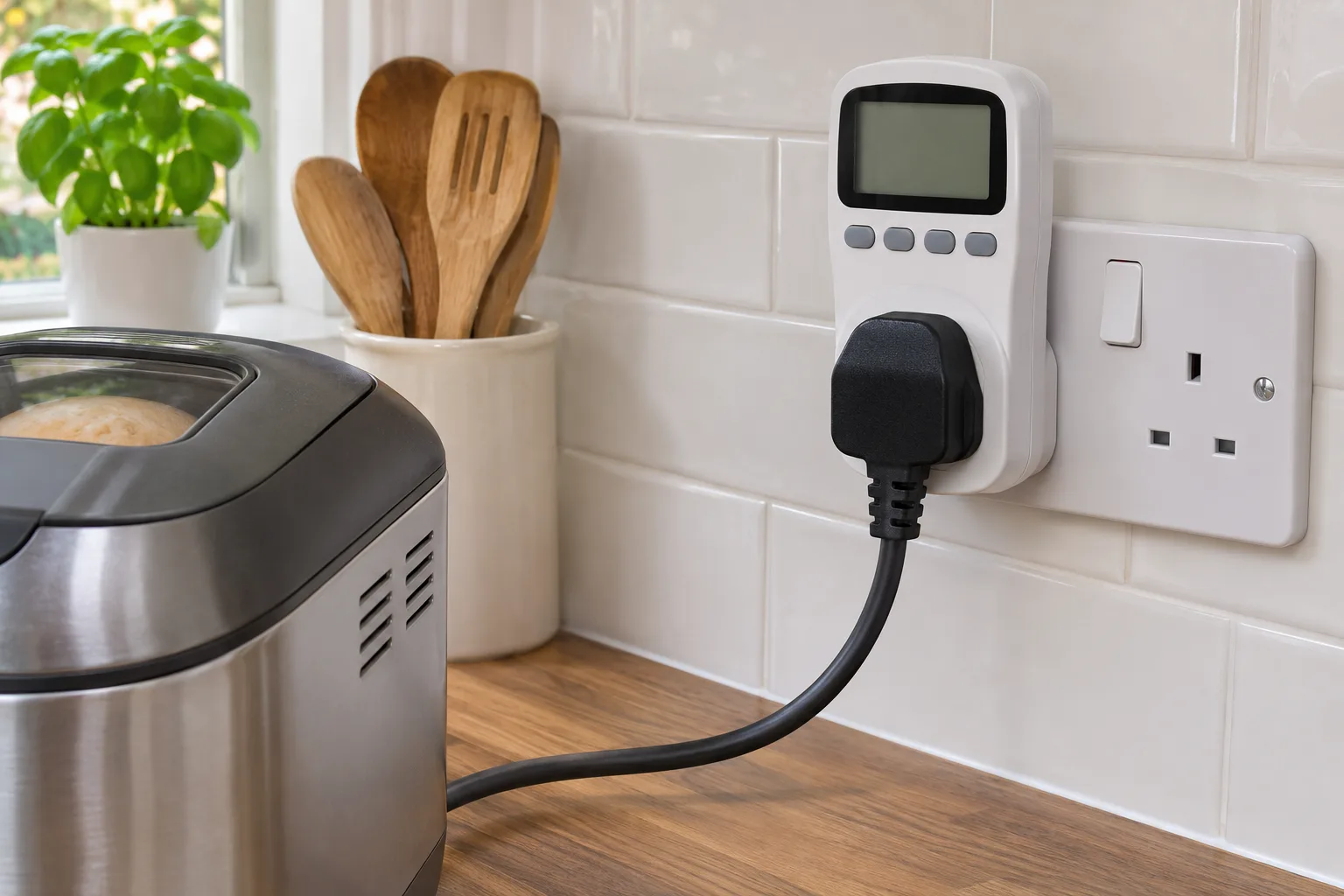
The reliable formula is cycle electricity (kWh) × your unit rate (£/kWh) = electricity cost for that loaf. You need energy consumed, not the wattage printed on the machine. A plug-in electricity meter can record kWh from the moment you start a programme until it finishes; your bill or supplier account gives the unit rate. Keep the standing charge out of this per-loaf calculation. You pay it for the household supply whether or not you bake that day.
Use your own unit rate for the electricity line. For a time-of-use tariff, match the rate to the hours when the programme runs. The measured kWh for a complete cycle matters more than the wattage on the appliance label.
Electricity is not the whole loaf bill
It helps to keep three lines separate:
- Electricity: measured kWh for the programme multiplied by the applicable unit rate.
- Ingredients: the quantities in your recipe priced from what you paid for the packs.
- Machine cost: an optional allocation of the purchase price across the loaves you expect to make.
That separation makes a supermarket comparison fairer. Saying that a loaf “costs 6p” after calculating only electricity leaves out the largest variable: what you put in the pan. Our bread maker loaf-size guide also explains why a 500g setting is not interchangeable with a 1kg recipe when you compare price per loaf.
What a monitored bread maker actually used
National Energy Action measured the Russell Hobbs 23620 rather than estimating consumption from its rating label. Its basic 500g, medium-crust cycle took 3 hours 10 minutes and used 0.21 kWh; its wholemeal 500g, medium-crust cycle took 3 hours 45 minutes and used 0.29 kWh. Those measurements apply to that machine and those settings. The report also records other programmes, showing why the recipe and menu belong beside any kWh figure.
The same report says the Russell Hobbs 23620 is rated at 660W. Multiplying 0.66 kW by the whole 3-hour-10-minute basic cycle would give about 2.09 kWh, roughly ten times the measured 0.21 kWh. That simple calculation is wrong because the heating element does not draw rated power continuously. Kneading, resting, warming and baking draw different amounts. In NEA’s recording, mixing was around 30–50W and the element drew much more while actually heating. A long cycle can therefore use surprisingly little electricity without the machine being “on at full power” the whole time.
Use the measurement as a sense-check, not a guarantee
Use the NEA results as a sense-check when comparing a published energy claim: look for the exact machine, loaf and crust settings, and a full-cycle kWh measurement. A larger loaf, darker crust, different recipe or rapid programme can change the result. The two measured cycles differ by 0.08 kWh; multiply that by your unit rate to see what the difference means in money.
If you are choosing a machine partly for its energy bill, ask whether a published figure is a full-cycle kWh measurement or merely a wattage specification. The two answer different questions. Our bread maker buying guide compares models for capacity and useful programmes; it does not turn a nameplate rating into an invented per-loaf energy bill.
Work through your own tariff example
The opening 5.25p–7.25p range uses NEA’s measured 0.21–0.29 kWh cycles and an illustrative 25p/kWh rate. For your own estimate, replace 25p with the rate on your bill and keep ingredients on a separate line. A time-of-use tariff may need more than one rate if the cycle crosses tariff periods.
To use your figures, write the energy reading in kWh with the same number of decimal places the meter provides. Convert the unit rate from pence to pounds if you want the answer in pounds: 0.21 kWh × £0.25/kWh = £0.0525. Or keep both in pence: 0.21 × 25p = 5.25p. A common spreadsheet error is to multiply by 25 and then label the result pounds; that inflates the answer a hundredfold.
Check which tariff line you are using
Look for the electricity unit rate on your own bill or account, not a gas rate, annual direct debit, standing charge or headline estimate of household spend. Ofgem explains what the energy price cap does and does not cover; it does not make every household’s unit rate identical. If you have off-peak pricing, a delayed overnight loaf could have a different electricity cost from a daytime loaf. Verify the applicable window before claiming a saving from the delay timer.
We prefer a reader-supplied tariff to an article that hard-codes this month’s pence per kWh. Rates move, and a fixed figure ages badly. Put the date and rate beside your worksheet so you can revisit it when your contract changes.
Add ingredients without guessing shelf prices
A bread maker does not make flour, yeast, salt or optional seeds free. Use the exact recipe for your chosen loaf size and the price on the packs you actually bought. For each ingredient, divide the pack price by the pack quantity, then multiply by the quantity used. A 1.5kg bag of flour can supply several loaves, so charging the full bag to one loaf is just as misleading as leaving flour out altogether.
A simple worksheet needs columns for ingredient, pack quantity, pack price, recipe quantity and calculated loaf cost. Keep units consistent: grams with grams, millilitres with millilitres. For ingredients measured by teaspoons, weigh a representative teaspoon or use a manufacturer recipe conversion before attempting a precise cost. Salt or yeast may be only pennies per loaf, but an enriched loaf with butter, milk, dried fruit or seeds is a different financial proposition from a basic white loaf. Do not apply one “homemade bread cost” to every recipe.
Allow for what you actually use
If you already own the oil or salt and want the incremental cash cost of tonight’s loaf, you may treat a tiny portion differently from a full shopping-list cost. State which comparison you are making. For a repeatable long-term loaf cost, include every consumed ingredient even if it came from the cupboard. For an immediate “must I go to the shop?” decision, cash outlay may be the more useful figure.
- Recipe quantity: copy it from the manual for the selected programme and loaf size.
- Pack price: use your current receipt from a UK shop such as Tesco, Aldi or Waitrose, not a stale online listing.
- Waste: if a specialist flour goes stale before you finish the bag, count that rather than assuming every gram became bread.
- Extras: toppings and fillings belong in the comparison if the supermarket loaf also includes them.
Our recommendation is to calculate one basic loaf you actually bake, then repeat for the richer loaf you buy most often. That tells you more than a generic internet average.
Where the machine purchase price fits
The cost of buying a bread maker is not electricity and should not be disguised as part of the unit-rate calculation. If you want an all-in estimate, divide the machine price by the number of loaves you realistically expect to bake during its useful life. A machine bought for an illustrative £100 and used for 200 loaves adds 50p per loaf before any repair or replacement parts; used for 20 loaves it adds £5. Those figures are deliberately hypothetical, not a claim about the current price or life of any model.
The difficult input is not the division; it is honest baking frequency. Baking twice a week for a year is roughly 104 loaves if you sustain it. Buying a machine, making three novelty loaves and putting it in a cupboard produces a very different cost. Avoid calculating a five-year return from a first week’s enthusiasm. If you already own the machine, its purchase price is a sunk cost for the question “what does the next loaf cost?”; ingredients and electricity still matter.
Repairs, pans and alternatives
Some machines need a replacement pan or paddle during their life. Include that expense only when it is plausible or incurred, and do not invent a universal replacement schedule. A second-hand machine can lower purchase cost but may have a worn non-stick pan or missing paddle; check that the exact replacement part is available before treating a bargain as cheap. A stand mixer route has different equipment and usually an oven finish; our stand mixer bread method is a useful comparison if you already own that kit.
We would buy for bread you want to eat and the convenience you value, then calculate payback conservatively. A promise that every household saves money ignores purchase frequency, recipe and waste.
How programmes and loaf size change the result
The NEA measurements show why one per-loaf electricity figure cannot cover every menu. Its Russell Hobbs wholemeal setting consumed 0.29 kWh against 0.21 kWh for the basic setting, with the same stated 500g and medium crust. The report describes a preheat stage and different timing for wholemeal. That is a specific observed difference, not proof that every wholemeal loaf everywhere costs more to run.
Bigger loaf settings may use more ingredients and produce more edible bread, so compare cost per kilogram of finished bread when two machines have different capacities. The label on the control panel is not necessarily the dough mass, and flour weight is not finished-loaf weight. We would weigh the cooled loaf if precision matters. A single larger loaf may reduce the number of baking sessions, but freshness matters: throwing away half a loaf erases an apparent saving. The loaf-size comparison helps match capacity to actual household consumption.
A dough-only programme also changes the accounting boundary. It may mix and prove without baking, after which you shape the dough and use an oven. You must count both the machine’s dough cycle and the oven’s bake if you want the complete energy cost. The sourdough workflow guide shows why a bread-maker-assisted loaf is not always a machine-baked loaf. Our preference for a fair cost comparison is to name the finishing method before quoting any kWh number.
Compare fairly with an oven or shop loaf
A bread maker heats a small baking chamber, but “cheaper than an oven” is not an automatic conclusion for your kitchen. An oven may bake several loaves or a full meal at once. Charge the entire oven cycle to one small loaf only if that loaf was the sole thing cooked. If the oven was already hot for dinner, allocating all of its energy to bread also distorts the comparison. Conversely, a dough-only bread-maker route adds energy before the oven bake.
NEA’s report discusses an oven estimate and possible savings for its scenario, but we would not reproduce the percentage as a general UK household promise. Measure both complete processes under the conditions you use, then decide whether you care about electricity alone or total money, time, crust and convenience. Our air-fryer wattage explainer makes the same power-versus-energy distinction for another kitchen appliance; high wattage for a short interval is not the whole running-cost story.
A shop-loaf comparison also needs equal quantity and reasonable quality. Compare the weight of bread you actually eat, not merely one homemade loaf against one packaged loaf with a different size. Include ingredients, electricity and, for a long-term view, machine cost. Shop promotions, a specialist gluten-free mix, an expensive seeded recipe and food waste can all change the result. There is no honest single “bread maker savings per year” number without your shopping and baking pattern.
Time is a separate decision
You may value a loaf ready in the morning even if it is not the lowest-cost option. The machine handles mixing, kneading and much of the timing; washing the pan and buying ingredients remain real tasks. We would not assign a pretend hourly wage to a hobby unless you genuinely use that figure to make purchasing decisions. Put convenience beside the money columns, not inside an unexplained cost total.
Measure your next loaf and make the buying decision
The most useful test is one normal loaf in your own kitchen. A suitable plug-in meter that records cumulative kWh can sit between the wall socket and bread maker. Check its rating and instructions for the appliance and socket, reset the reading, then run the complete programme you normally use. Record the start and end kWh, programme, loaf setting, crust setting, recipe, date and tariff. Do not use an extension lead or meter contrary to its instructions. If the cycle includes an automatic keep-warm period that you use, decide whether to include it and label the boundary clearly.
- Measure: note the complete-cycle kWh rather than multiplying the rated watts by elapsed hours.
- Price electricity: multiply measured kWh by the unit rate that applied during the run.
- Price ingredients: allocate each pack by the recipe quantity, then add the rows.
- Choose your question: stop there for the next-loaf cost, or add realistic machine amortisation for an all-in estimate.
- Compare like with like: weigh the finished loaf and account for oven finishing or wasted bread if relevant.
If you are still shopping, use this method to interrogate running-cost claims, but make the bigger decision on capacity, the programmes you will actually use, pan and paddle availability, and the kind of loaf you enjoy. The current bread-maker buying guide is the next step for model comparisons. We would rather recommend a machine that gets regular use than a theoretically efficient one that never leaves the cupboard.
Frequently Asked Questions
How much electricity does a bread maker use for one loaf? In National Energy Action’s test, a Russell Hobbs 23620 used 0.21 kWh on a basic 500g medium-crust cycle and 0.29 kWh on a wholemeal 500g medium-crust cycle. Measure your own model and settings rather than treating either figure as universal.
Can I multiply the bread maker’s wattage by three hours? No. The rated wattage is not a continuous draw throughout mixing, resting, proving and baking. Use a complete-cycle kWh reading instead.
Does a delayed start make bread cheaper? Only if your tariff charges less during the hours when energy is used. A delay timer alone does not change the kWh formula, and the programme may extend across more than one tariff period.
Should I include the price of the machine in each loaf? Include a realistic share of the purchase price for a long-term all-in comparison. Leave it separate when you only want the additional cost of baking the next loaf in a machine you already own.
Is a bread maker always cheaper than an oven? No. An oven used for several items at once, a dough-only cycle followed by oven baking, and different loaf sizes change the comparison. Measure the complete process you use.
Are ingredients or electricity usually more important? That depends on your recipe, pack prices and tariff. Calculate both independently; a rich or specialist-flour loaf can differ sharply from a basic white recipe.