An air fryer’s wattage tells you its maximum electrical input, not how crisp its chips will be or exactly what every meal will cost. For anyone searching for air fryer wattage power running cost explained, the useful answer is simple: combine the wattage with cooking time and your electricity unit rate, then judge that result alongside basket size. A well-sized 1,500W air fryer can be cheaper to run than a lower-powered machine that needs two batches, while a 2,400W dual-zone model is not automatically expensive if you only heat one drawer.
In This Article
- Air Fryer Wattage Power Running Cost Explained: The Short Answer
- What Air Fryer Wattage Actually Means
- Typical Air Fryer Wattage by Size and Type
- Does a Higher-Wattage Air Fryer Cook Faster?
- How to Calculate Air Fryer Running Cost
- Air Fryer Running Cost Examples
- Air Fryer Versus Oven Electricity Use
- Choose the Right Wattage Without Overbuying
- Frequently Asked Questions
Air Fryer Wattage Power Running Cost Explained: The Short Answer
Most domestic air fryers sold in the UK sit somewhere between about 1,000W and 2,500W. Compact single-drawer models tend to be at the lower end, family-sized and dual-drawer machines at the upper end. That number is the appliance’s maximum rated power draw. It does not mean the heating element consumes that amount continuously from switch-on to switch-off.
The three points that matter
- Wattage affects potential heat output: a higher rating can help a larger cooking chamber recover heat after cold food goes in.
- Time determines energy use: a 2,000W appliance used for 15 minutes can consume less electricity than a 1,200W appliance used for 35 minutes.
- Capacity determines whether one batch is enough: repeating a cycle can erase the apparent saving from buying the smallest model.
My view is that wattage should be a sense-check, not the deciding specification. Choose the basket arrangement that fits a normal meal, then compare power ratings among machines of similar capacity. If you are still choosing a model, our guide to the best air fryers in the UK compares the whole package rather than rewarding the biggest number on the box.
What Air Fryer Wattage Actually Means
Watts measure power: the rate at which an appliance uses electrical energy at a given moment. A 1,500W air fryer is rated to draw up to 1.5 kilowatts when its heating system is operating at full load. Energy suppliers bill in kilowatt-hours, so power must be combined with time before it becomes a cost.
Rated power is not measured energy
The label usually gives a maximum or nominal input. Once the chamber approaches the selected temperature, the thermostat cycles the heating element on and off. The fan and electronics continue to use some electricity, but the large heating element is not necessarily energised for every second of the programme.
That is why the simple wattage formula gives an upper-bound estimate rather than a laboratory measurement. When reviewing appliance running-cost claims, I distrust calculations that multiply maximum power by time and then present the answer as exact to the fraction of a penny. It is a useful comparison, but a plug-in energy meter gives a better figure for your food, programme and machine.
Where to find the rating
Check these places in order:
- Rating plate: normally on the underside or rear, showing watts or volts and amps.
- Instruction manual: look under technical specifications rather than the marketing pages.
- Manufacturer product page: use the exact model code because similar-looking sizes can have different ratings.
Do not confuse watts with temperature. A 1,200W and 2,000W air fryer may both reach 200°C; the difference is how quickly and under what load they can supply heat. Likewise, litres describe nominal chamber capacity, not guaranteed usable food area. A wide 5-litre basket can cook chips more evenly than a narrow 6-litre basket because more food sits in one layer.
Typical Air Fryer Wattage by Size and Type
There is no official banding system, but current UK products broadly fall into four groups. Treat the ranges as shopping guidance because manufacturers revise models and may quote slightly different figures across territories.
Compact single-drawer models: roughly 1,000–1,400W
These usually have around 2–4 litres of stated capacity and suit one person, couples or side dishes. Their lower maximum input can keep the headline cost down, but the small basket is the real limitation. If dinner needs two consecutive batches, total energy and time both rise.
For a small household that cooks one basket at a time, this category makes sense. Our air fryers under £100 guide includes compact options where usable basket shape matters more than chasing extra watts.
Standard single-drawer models: roughly 1,400–1,800W
This is the sensible middle ground for many kitchens. Capacities around 4–7 litres can handle a useful portion without the footprint and peak demand of a large dual-zone appliance. A well-designed 1,500W machine is enough for chips, chicken portions, vegetables and reheating.
Based on checking current specifications across common UK ranges, there is no clean performance dividing line at 1,500W or 1,700W. Airflow, basket geometry and control accuracy create more noticeable differences than a 100W gap.
Dual-zone models: roughly 1,700–2,500W
Dual-drawer machines have more air to heat and may power two elements, so a higher total rating is unsurprising. The benefit is not merely capacity: separate zones let you cook two foods at different temperatures and finish together. See our explanation of the best dual-zone air fryers if that flexibility is the priority.
The important question is whether the quoted rating applies to both zones together. Some appliances manage available power between drawers rather than drawing the full rating for each. Using one drawer may therefore consume much less than the nameplate maximum for the full machine.
Air fryer ovens: roughly 1,600–2,200W
Oven-style air fryers add shelves, doors and a larger cavity. They can be useful for toast, trays, rotisserie cooking and larger portions, but their energy advantage over a conventional oven narrows as the chamber grows. Read our air fryer oven buying guide if shelf space and versatility matter more than the lowest possible running cost.
Does a Higher-Wattage Air Fryer Cook Faster?
Sometimes, but the relationship is not one-to-one. Doubling the wattage does not halve the cooking time. The food still needs time for heat to move from its surface towards the centre, moisture to escape and browning reactions to develop.
Where extra power helps
A higher-powered machine can:
- Preheat more quickly: particularly when the chamber and basket start cold.
- Recover temperature: cold or frozen food absorbs heat as soon as it enters.
- Support a larger chamber: more surface area and air volume increase heat demand.
- Run two zones: separate drawers need sufficient power when used together.
Where it does not solve the problem
An overcrowded basket blocks airflow, whatever the wattage. Chips piled deeply will steam against each other and brown unevenly. A powerful element cannot fix a fan that distributes hot air poorly, a thermostat that overshoots, or a narrow basket with little cooking surface.
When checking air-fryer manuals and cooking charts, I find that model-to-model times vary far less predictably than the wattage figures suggest. Use the manufacturer’s programme as a starting point, then check early. Our air fryer cooking-times chart gives practical ranges, while your own first batch tells you more about the appliance than its power badge.
Food load often matters most
A 1,500W air fryer cooking 500g of chips in one loose layer may finish before a 2,000W model loaded with 1kg. If you regularly feed four people, buy enough usable basket area rather than selecting a compact unit because its maximum cost per minute looks lower.
How to Calculate Air Fryer Running Cost
You need three figures: rated watts, cooking time and your electricity unit rate. The current Ofgem average for a standard-variable electricity tariff paid by Direct Debit is 26.11p per kWh for 1 July to 30 September 2026, including VAT. Your bill may differ by region, tariff and payment method, so use the number shown by your supplier. Ofgem publishes the current unit rates and standing charges.
The formula
- Convert watts to kilowatts: divide the wattage by 1,000.
- Convert minutes to hours: divide the cooking time by 60.
- Calculate kilowatt-hours: multiply kilowatts by hours.
- Calculate cost: multiply kWh by your electricity price in pence.
For a 1,500W air fryer running for 20 minutes:
1.5kW × 0.333 hours = 0.5kWh
0.5kWh × 26.11p = 13.06p
That is the maximum-rating estimate. Because the element cycles, measured consumption may be lower. The calculation also excludes the standing charge, which you pay for having the supply available whether or not the air fryer is used; adding it to one cooking session would be misleading.
Measure it instead of guessing
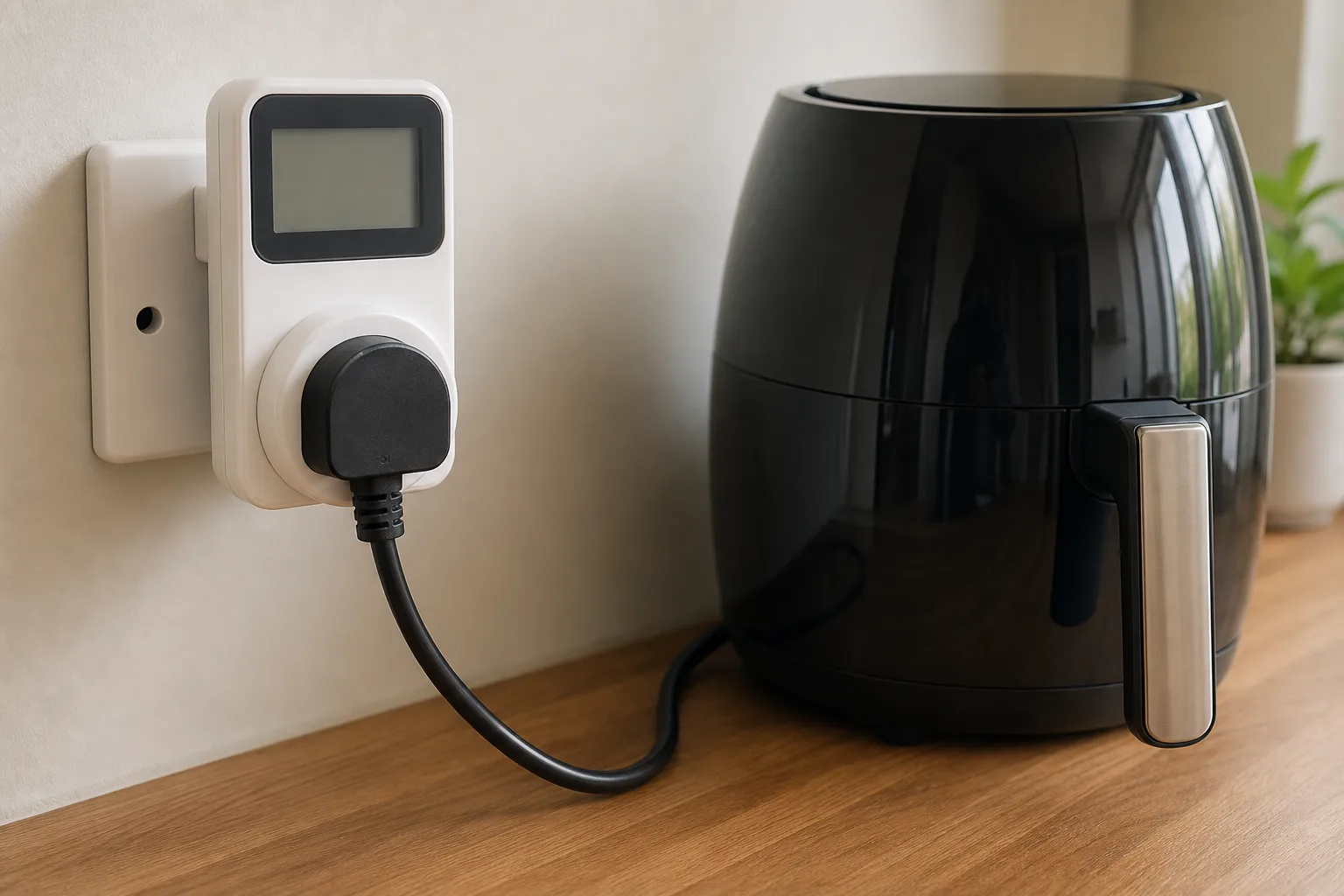
A UK plug-in energy monitor, often £15–£25 from Screwfix, Amazon UK or electrical retailers, records actual kWh. Plug the monitor into the wall, plug the air fryer into the monitor, reset it, then run a normal cooking cycle. Do not use an adaptor that is not rated for the appliance’s load, and keep plugs and cables clear of hot exhaust vents.
The best measurement is not an empty preheat test. Cook a representative meal from cold, including preheating if you normally use it. For a dual-zone model, measure one drawer and both drawers separately. That produces figures you can use, rather than a flattering best case.
Air Fryer Running Cost Examples
The table below uses 26.11p/kWh and assumes the appliance draws its full rated power for the whole period. Real thermostat-controlled use can be lower, so these are cautious comparison figures rather than promises.
| Rated power | 15 minutes | 20 minutes | 30 minutes | 45 minutes |
|---|---|---|---|---|
| 1,200W | 7.83p | 10.44p | 15.67p | 23.50p |
| 1,500W | 9.79p | 13.06p | 19.58p | 29.37p |
| 1,700W | 11.10p | 14.80p | 22.19p | 33.29p |
| 2,000W | 13.06p | 17.41p | 26.11p | 39.17p |
| 2,400W | 15.67p | 20.89p | 31.33p | 47.00p |
Why the highest number can mislead
Imagine a 1,200W compact model needs two 30-minute batches for a family meal. Its upper-bound total is about 31.3p. A 2,000W family model finishing the same quantity in one 30-minute batch is about 26.1p. The higher-wattage appliance wins because capacity avoids repetition.
The reverse can also be true. Heating a large dual-zone machine for one bread roll wastes capacity. For small portions, a compact drawer or one independently controlled zone is the better match.
Air Fryer Versus Oven Electricity Use
Air fryers often use less electricity for small and medium portions because the chamber is smaller, the fan moves hot air quickly and little or no preheating is needed. The advantage is workload-specific, not universal.
When the air fryer usually wins
- One or two portions: there is no reason to heat a full oven cavity.
- Short, crisp cooking: chips, vegetables, chicken pieces and reheated pastry suit concentrated airflow.
- Separate foods: dual zones can replace both oven and hob for a small meal.
- Reheating: the result is often crisper than a microwave without a long oven preheat.
In a 2026 controlled comparison, Which? reported about 7p to cook two portions of chips in its selected air fryer versus 23p in the electric oven used for the same quantity. Its method measured actual energy, including preheating and cooking, which is more useful than comparing nameplate watts alone. Which? explains its air-fryer and oven energy comparison.
When the oven can make more sense
A full oven becomes competitive when several shelves are used at once, you are cooking a large joint or casserole, or the food simply does not fit without multiple air-fryer batches. If Sunday lunch needs three back-to-back drawer cycles, the lower wattage has not bought much convenience.
You should compare complete meals, not appliances in isolation. A 25-minute air-fryer main plus two pans on the hob may use more energy than one well-loaded oven. Cost matters, but timing, food quality and the number of batches matter too.
Choose the Right Wattage Without Overbuying
Start with what you cook on an ordinary Tuesday, not the largest meal you host once a year. Capacity and layout determine whether the appliance earns its worktop space; wattage then tells you whether its electrical demand looks proportionate.
Match the machine to the household
- One person or light reheating: roughly 2–4 litres and 1,000–1,400W can be enough.
- Couple or small family: roughly 4–7 litres and 1,400–1,800W is a useful range.
- Family cooking or two foods: a large basket or dual zone around 1,700–2,500W may avoid repeat batches.
- Tray-style cooking: consider an air fryer oven, accepting that its larger chamber narrows the energy advantage.
Large households should compare usable dimensions in our guide to family-sized air fryers. Quoted litres are not perfectly comparable: drawer shape and recommended fill depth affect how much food can crisp properly.
Reduce cost without compromising dinner
- Skip unnecessary preheating: use it when the recipe depends on immediate high heat, not by habit.
- Cook one efficient batch: leave enough space for airflow but avoid an undersized basket that forces a second cycle.
- Use the right zone: on a dual model, heat one drawer for a small portion where the controls allow it.
- Check before the timer ends: air fryers vary, and five unnecessary minutes costs energy and dries food.
- Keep airflow clear: grease and crumbs around the intake, fan area and crisper plate undermine performance. Follow our guide to cleaning an air fryer properly.
The bottom line: do not pay extra for wattage alone, and do not reject a useful family machine because its maximum rating looks high. Buy the smallest layout that cooks your normal meal in one sensible batch. Then use your tariff and actual cooking time to work out the cost.
Frequently Asked Questions
Is a 1,500W air fryer expensive to run? At 26.11p/kWh, 20 minutes at the full 1,500W rating costs about 13.1p. Actual use can be lower because the heating element cycles once the set temperature is reached.
Does a 2,000W air fryer use 2kWh every hour? It would use 2kWh only if it drew the full 2,000W continuously for a complete hour. Normal programmes are shorter and thermostat cycling can reduce measured consumption.
Is a lower-wattage air fryer always cheaper? No. A smaller model may need longer cooking or a second batch. Compare the energy for the whole quantity of food, not the cost per minute.
Do dual air fryers use full power when one drawer is running? Not necessarily. Designs manage zones differently, so check the exact manual or measure one-drawer use with a suitable plug-in energy monitor.
Should I include the electricity standing charge? No, not when comparing one cooking session. You pay the standing charge for the supply regardless of whether the air fryer, oven or neither is used.
What wattage is best for an air fryer? There is no single best figure. Around 1,400–1,800W suits many standard single-drawer models, while large and dual-zone machines reasonably need more. Basket size, airflow and avoiding repeat batches matter more.