This air fryer size guide starts at 2–4 litres for one person, 3–5 litres for two, 5–7 litres for three or four, and 7 litres or more for larger households. Choosing by litres alone is unreliable, though: the basket’s usable floor area and the meals you cook matter more than the headline capacity.
For this air fryer size guide, we treat litres as a starting point and give more weight to basket shape, food type and whether dinner needs to cook in one batch or two. A wide 5-litre basket can be more useful than a narrow 6-litre basket if you regularly cook chicken, fish or vegetables in a single layer.
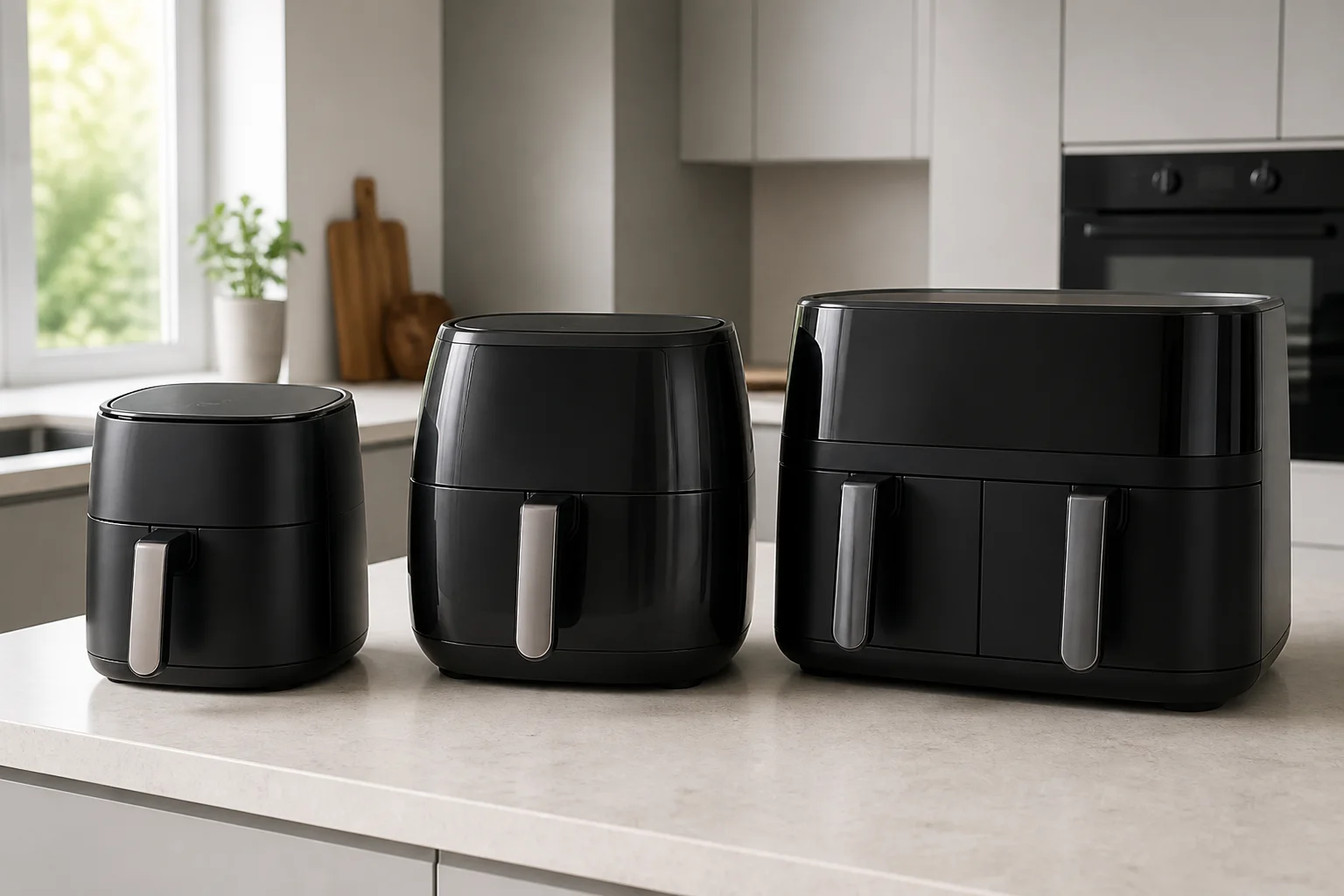
The Quick Air Fryer Size Guide
Use the table below as a shortlist, not a promise that every appliance of the same stated capacity will hold the same amount of food.
| Household or use | Useful starting capacity | Best suited to | Watch for |
|---|---|---|---|
| One person | 2–4 litres | Single portions, sides, reheating | Very small baskets may not fit a full meal in one layer |
| Two people | 3–5 litres | Two portions of chips, vegetables, fish or chicken | Check basket width if cooking two large items |
| Three to four people | 5–7 litres | Family sides and straightforward one-basket meals | A second batch may still be needed for mixed meals |
| Four to six people | 7–10 litres or dual zone | Larger portions or two foods at once | Combined dual-zone capacity can exaggerate each drawer’s usable size |
| Batch cooking or entertaining | 9 litres plus or oven style | Several portions, trays and varied foods | Large footprints, longer warm-up and more cleaning parts |
These bands work best when you also ask three questions:
- What is the largest item you expect to cook: a portion of chips, two chicken breasts, a whole chicken or a small pizza?
- Do you want a complete meal ready together, or are you happy to cook components in separate batches?
- Will the appliance stay on the worktop, and does the drawer have enough room to open fully?
If you already know that you need a roomy model, our guide to the best large air fryers narrows the current options. If your budget is the main constraint, start with our best air fryers under £100 instead.
A practical capacity rule
Buy for the food you cook most often, not for the biggest meal you might make twice a year. A couple who mainly reheats leftovers and cooks side dishes may be comfortable with 3–4 litres. The same couple may want 5–6 litres if they cook two generous salmon fillets, breaded chicken or a full tray of roasted vegetables.
For families, the useful question is not simply “how many people?” It is “how much food needs exposed basket space at the same time?” Air fryers circulate hot air, so piling ingredients deeply can make cooking less even and reduce browning. More nominal volume does not help if most of it is vertical space you cannot use effectively for the meal.
Why Litres Do Not Tell the Whole Story
Manufacturers normally lead with a capacity in litres, kilograms or portions. These figures are useful for comparing variants within one range, but they are not a standard measure of how much food will cook well in a single layer.
Which? explains that stated capacity can differ from usable tested capacity, and it advises checking external dimensions as well as litres. That distinction matters because two 5-litre models can have different basket widths, corner shapes and internal fittings.
Basket floor area often matters most
Foods such as chips can tolerate some stacking if they are shaken during cooking. Burgers, fish fillets, breaded chicken and many vegetables benefit from more direct exposure to moving hot air. A wide, square basket can therefore be more useful than a taller, narrower one with a larger advertised capacity.
When comparing models, look for:
- Internal basket width and length, where the manufacturer publishes them.
- A square or rectangular floor rather than a narrow circular basket.
- Space lost to a crisper plate, central divider or rounded sides.
- Whether a divider can be removed to create one larger cooking zone.
- The quantity and shape of food shown in reliable product demonstrations.
Do not assume that a dual-zone model labelled 9 litres has one 9-litre cooking area. It may have two separate 4.5-litre drawers. That can be excellent for cooking a main and a side independently, but neither drawer will fit an item that needs one wide 9-litre cavity.
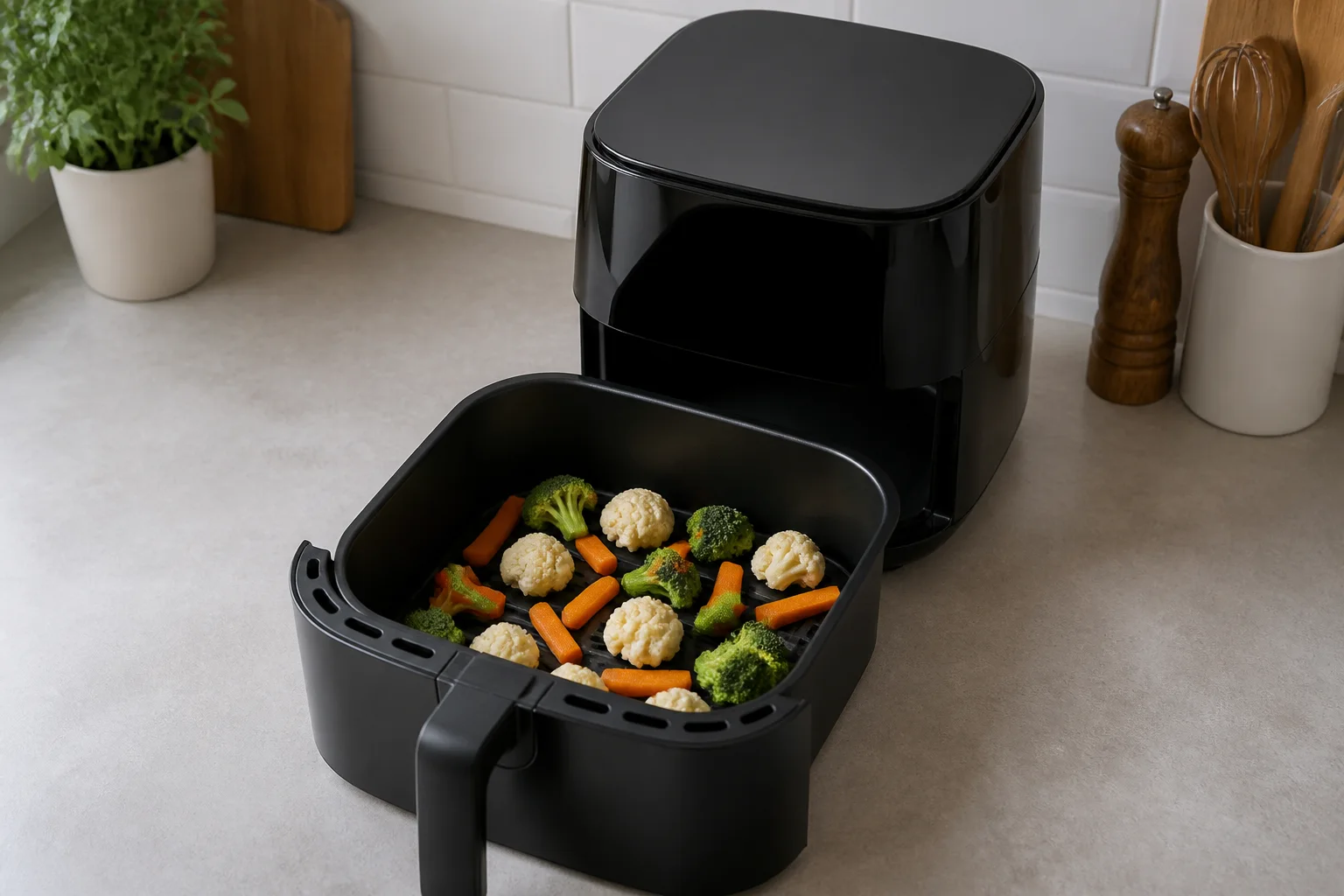
Portion claims need context
A portion of chips is not the same as a complete dinner, and serving sizes vary. One manufacturer might quote frozen chips, another a whole chicken and another a weight limit. For example, Tefal describes one specific ActiFry model as holding 1kg or four portions. That is useful information for that appliance, not a universal conversion between kilograms, litres and people.
When we compare current UK models, we separate manufacturer serving claims from usable cooking space. Treat “feeds four” as an indication to investigate further, not the final answer.
What Size Air Fryer Do You Need for One or Two People?
For one person, a 2–4-litre model is usually the sensible range. It keeps the footprint and cleaning burden modest while leaving enough room for a portion of protein, vegetables or chips. The smallest 1–2-litre appliances can work for snacks and sides, but they are easy to outgrow if the air fryer becomes your main oven alternative.
For two people, 3–5 litres is a better starting range. Move towards the upper end if you want two substantial portions ready at once or regularly cook foods that should not overlap. A 5-litre square basket is often a more flexible choice than an ultra-compact unit, without taking up the space of a family-sized dual-zone model.
When a compact model makes sense
A compact air fryer suits you if:
- You mostly cook for one.
- It will be used for reheating, snacks or side dishes.
- Worktop or cupboard space is tight.
- You do not mind cooking a main item and side separately.
- Lower purchase cost matters more than maximum flexibility.
Small models avoid heating an unnecessarily large cavity for a modest portion. That does not guarantee lower running costs: rated wattage, cooking time and usage pattern all influence energy consumption. Our guide to air fryer wattage and running costs explains why capacity alone does not determine the electricity used.
When two people should size up
Choose around 5–6 litres if you want to cook a full two-person meal in one basket, prepare extra portions for lunch, or fit larger ingredients without cutting them down. This is also a safer choice if appetites are generous or the air fryer will replace much of your conventional-oven use.
Do not size up automatically because a larger model is discounted. An appliance that dominates the worktop and is awkward to clean may be used less often, even if its price looks attractive.
What Size Air Fryer Do You Need for a Family?
For three or four people, start at 5–7 litres for a single basket. This can handle a useful quantity of chips, vegetables or chicken pieces, although a complete family meal may still require batches. If you expect a main and side to finish together, a dual-zone model is often more convenient than one deeper basket.
For four to six people, look at 7–10 litres, two sizeable drawers or an air fryer oven with multiple racks. The right format depends on whether your meals need one broad space or two independent cooking zones.
Family size is not the same as meal size
A household of four with two young children may need less capacity than three adults. Equally, a family that batch cooks, hosts regularly or prepares packed-lunch portions may need more space than its headcount suggests.
Use a typical midweek dinner as your test case. Write down the main item, side and vegetables, then decide which components must be air fried. You may find that only the chips need the basket while the rest cooks on the hob. In that case, one large drawer may be enough. If chicken and vegetables both need different temperatures, two zones have a clearer advantage.
The one-batch test
Before buying, ask whether these common foods would fit without excessive stacking:
- The number of chicken breasts or fish fillets your household normally eats.
- Enough chips or roast potatoes for everyone.
- A whole chicken of the size you usually buy, if that is a priority.
- The pizza, pie dish or baking tin you actually intend to use.
- Batch-cooked portions plus room for air to circulate.
If the answer is no, decide whether a second batch is acceptable. Cooking twice is not necessarily a problem for occasional use, but it is frustrating when it becomes the default for every dinner.
For a broader view of current sizes and formats, see our main best air fryers guide.
Single Basket, Dual Zone or Air Fryer Oven?
Capacity figures become more meaningful once you choose the right format. A 7-litre single drawer, a 9-litre dual-zone model and a 12-litre air fryer oven solve different problems.
Single-basket air fryers
Single drawers are usually straightforward to load, shake and clean. They make good use of their footprint and suit households that cook one type of food at a time. A wide single basket is particularly useful for larger items and can be more flexible than two narrow drawers.
Their limitation is timing. If one food needs 200°C and another 170°C, you must compromise, add ingredients at different times or cook in batches.
Dual-zone air fryers
Dual-zone models let you set different times and temperatures, often with a function that finishes both zones together. They suit mixed meals and households with different preferences. Our guide to the best dual-zone air fryers covers that format in detail.
Check the capacity of each drawer, not only the combined figure. Two 4-litre zones are versatile for a main and side, but a large chicken or baking dish may not fit either one. Some newer designs use one wide drawer with a removable divider, which can offer a useful compromise, but the exact internal dimensions still matter.
Air fryer ovens
Oven-style models use shelves, racks or trays behind a front door. They can provide the broadest usable area and may suit toast, pizza, baking or several small portions. They are not automatically better for chips: rotating trays and swapping shelf positions may be needed for even results.
They also have more parts to clean and usually occupy more worktop space. If you primarily want fast portions of chips and chicken for two people, a drawer model is likely simpler. If you want a compact second oven for varied cooking, the oven format can justify its size.
Measure the Space Before You Buy
External size is part of capacity. A larger air fryer is only useful if it can be positioned safely, opened easily and used without moving half the kitchen.
Measure the intended space in three dimensions:
- Width: include clearance beside the appliance and room for nearby handles or cupboard doors.
- Depth: allow for the plug, power cable and the manufacturer’s ventilation guidance behind the unit.
- Height: check the gap beneath wall cupboards and whether hot exhaust air is directed upwards or backwards.
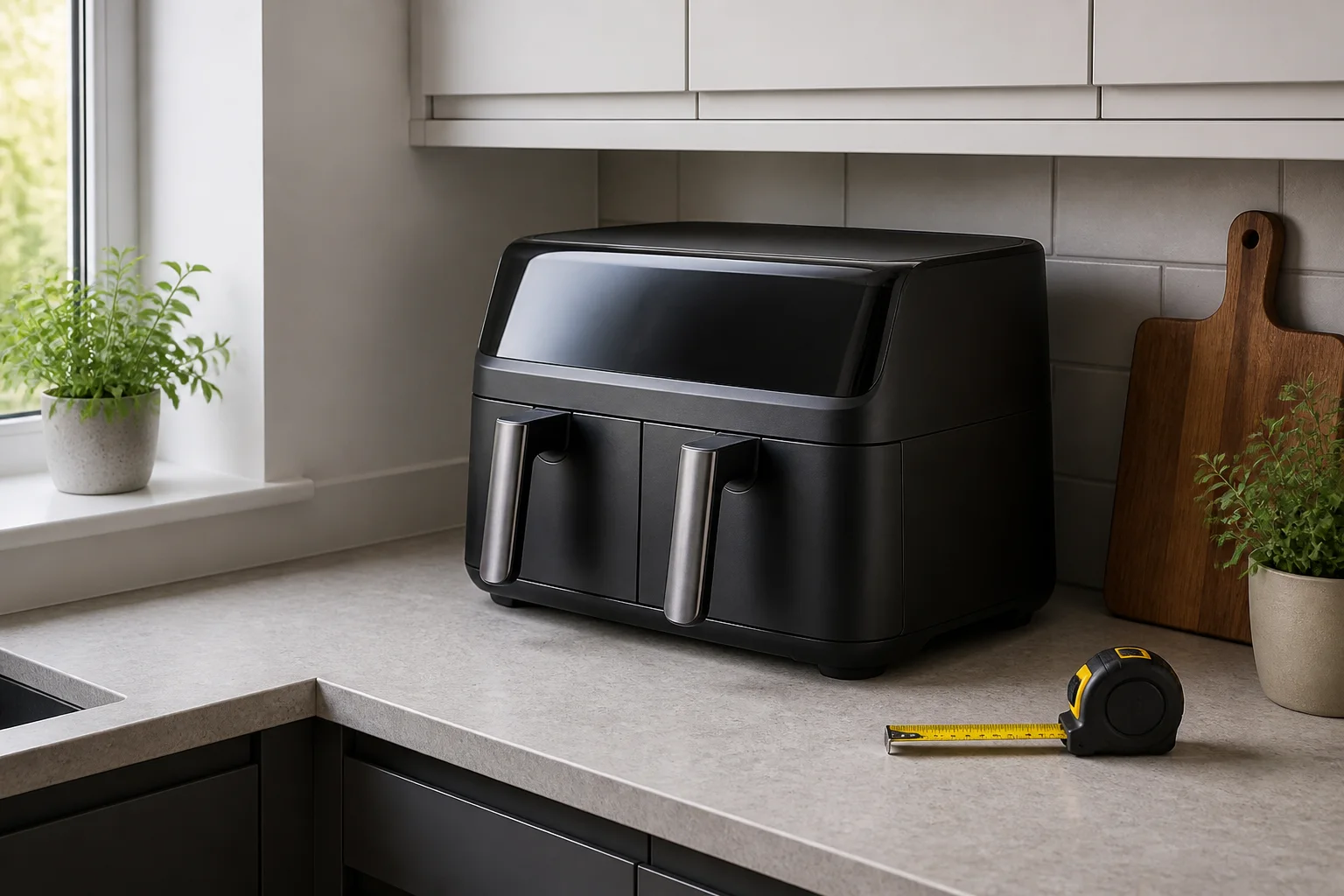
Then measure the operating space using the exact model’s published dimensions. The open drawer can project well beyond the closed appliance, and you need somewhere heat-resistant to put a hot basket or tray. Oven-style doors need clear space in front. If you plan to store the appliance, confirm its weight and the cupboard shelf dimensions too.
Do not ignore ventilation clearance
Air fryers release hot air and steam. Follow the clearance instructions for the exact model rather than relying on a generic distance. Do not operate one pushed against a wall, beneath a low shelf or on a surface that the manufacturer does not approve.
The power cable must reach a suitable socket without an unsafe extension arrangement or trailing across a hob. If your chosen position makes the appliance inconvenient to use, a smaller capacity may be the better long-term choice.
Compare footprint, not just volume
Dual-zone models are often wide. Deep single-basket models can project further from the wall. Air fryer ovens are usually taller. Product dimensions reveal these differences much better than litres.
When shopping online, make a cardboard footprint from the listed width and depth and place it on your counter. Mark the height against the splashback or wall. It is a simple way to see whether the appliance will crowd food-preparation space before it arrives.
Common Air Fryer Sizing Mistakes
The wrong size is not always the smallest model. Buying too large can be just as inconvenient as buying too small.
Assuming one litre equals one portion
There is no dependable one-litre-per-person rule. Food density, basket shape and the definition of a portion all vary. Use household bands to shortlist capacities, then check what physically fits.
Buying for rare occasions
Choosing a huge model for Christmas snacks or occasional guests can leave you with an oversized appliance all year. Size for normal use and accept a second batch on rare occasions, unless entertaining is genuinely frequent.
Focusing only on chips
Chips can be shaken and redistributed. Fillets, burgers, steaks, toast and baking tins depend more heavily on width and shape. Check your hardest-to-fit regular food, not the easiest one.
Treating combined dual-zone capacity as one cavity
A combined 9-litre label may mean two separate 4.5-litre drawers. That is useful for variety but does not create a wide 9-litre space. Check whether the divider is fixed or removable.
Forgetting the open drawer
The closed dimensions do not show how much room is needed during cooking. Measure the drawer or door swing and leave a safe landing area for hot components.
Assuming bigger always means better value
Large appliances can cost more, occupy more space and add cleaning. According to Which?, basic models can start around £60 while feature-rich machines may exceed £200; price rises with more than capacity alone. Compare the format and features you will use rather than paying for maximum litres by default.
The Bottom Line: Which Capacity Should You Choose?
Start with 2–4 litres for one person, 3–5 litres for two, 5–7 litres for three or four, and 7 litres or more for larger households. Then adjust that range using your real meals.
Choose a wider basket if you cook fillets, burgers, chicken pieces or vegetables in one layer. Choose dual zones if two foods regularly need different settings. Consider an air fryer oven if shelves, baking and a broad cavity matter more than quick drawer-basket cooking.
Our recommendation is deliberately based on the meals you cook most often, not the largest number printed on the box. Check the internal shape, each drawer’s capacity and the external dimensions before buying. A model that fits your food and your kitchen is better than one that simply claims more litres.
Frequently Asked Questions
Is a 4-litre air fryer big enough for two people?
Usually, yes. A 4-litre basket can suit two portions of chips, vegetables or smaller protein items. Check the basket width if you want two large chicken breasts or fish fillets to sit flat, and expect some complete meals to need separate batches.
What size air fryer is best for a family of four?
A 5–7-litre single basket is a practical starting point for four people. Choose a larger or dual-zone model if you want a main and side ready together, cook generous portions or prefer not to run a second batch.
Is a 9-litre air fryer too big for two people?
It can be, but not always. A 9-litre dual-zone model may be useful for two people who batch cook or want separate settings. If you mainly reheat food or cook one component, a 3–5-litre model will usually use less worktop space and be easier to clean.
Does a bigger air fryer take longer to cook?
Not necessarily. Cooking time depends on food quantity, wattage, temperature, airflow and basket loading. A larger appliance cooking a small portion may not be the most efficient choice, while an overcrowded small basket can require extra shaking or a second batch.
Can you cook a whole chicken in a 5-litre air fryer?
Some 5-litre baskets can hold a small chicken, but litres alone cannot confirm it. Compare the chicken’s dimensions and weight with the manufacturer’s stated limits and the basket’s usable width and height. Leave enough clearance for hot air to circulate.
Is one large basket better than two smaller drawers?
One large basket is better for broad or bulky food. Two drawers are better when different foods need separate temperatures or cooking times. The right option depends on whether your normal meals need one uninterrupted space or two independent zones.