The stand mixer vs food processor decision comes down to the work you want the machine to do most often. Buy a stand mixer if bread, cakes, pastry and whipped mixtures are your priority; buy a food processor if chopping, slicing, grating and fast everyday preparation take more of your time. They overlap at the edges, but they are not interchangeable.
In This Article
- Stand Mixer vs Food Processor: The Quick Verdict
- What Each Appliance Is Designed to Do
- Task-by-Task Comparison
- Baking: Mixing, Whisking and Kneading
- Food Preparation: Chopping, Slicing, Grating and Puréeing
- Space, Storage and Cleaning
- Price, Attachments and the Cost of Overlap
- Which Should You Buy?
- Frequently Asked Questions
Stand Mixer vs Food Processor: The Quick Verdict
A stand mixer is the better choice for regular bakers. Its open bowl, planetary mixing action and task-specific beater, whisk and dough hook are designed for cake batter, buttercream, meringue and bread dough. It works while you weigh the next ingredient or tidy the worktop, and you can see and adjust the mixture without dismantling a lid.
A food processor is the better choice for everyday meal preparation. Its fast blade and feed tube turn chopping, slicing and grating into short jobs. It can also mix some doughs and batters, but that overlap is a useful extra rather than the main reason to buy one.
Our recommendation is based on the tasks each machine performs with its standard tools, not on the longest attachment list. That matters because optional accessories vary by model and can make a capable machine look more versatile on paper than it will be in your kitchen.
Choose a stand mixer if you:
- Bake at least weekly, particularly bread, enriched dough, cakes or meringue.
- Want hands-free mixing while you prepare other ingredients.
- Need gradual, controlled mixing rather than a short burst from a fast blade.
Choose a food processor if you:
- Prepare vegetables frequently and want quick, even slices or gratings.
- Make sauces, dips, pastry or breadcrumbs more often than elaborate bakes.
- Want one compact base to handle several short preparation jobs.
The biggest buying mistake is choosing on the basis of one overlapping task. A food processor that can knead a small dough is not automatically a good bread-making machine, just as a stand mixer with a slicer attachment is not automatically the quickest processor to set up for Tuesday-night vegetables.
What Each Appliance Is Designed to Do
The difference is easier to understand when you look at how the machines work rather than how many accessories appear in the box.
A stand mixer works around a bowl
A stand mixer moves a tool through a fixed bowl. The standard tools normally include a flat beater for cake mixtures and general mixing, a balloon whisk for aeration, and a dough hook for kneading. The head and motor are built to keep those tools moving through mixtures that range from light egg whites to resistant bread dough.
The open bowl is an important part of the design. You can add flour gradually, scrape down the sides and judge texture while the machine is stopped. Bowl covers and splash guards are useful, but the appliance does not rely on a locked processing lid for its core jobs.
This is why the stand mixer earns its space for someone who bakes regularly. If that sounds like your kitchen, our guide to the best stand mixers in the UK covers current buying considerations after you have settled the appliance-type decision.
A food processor works around a blade or disc
A food processor drives a central blade or a disc at speed inside a lidded bowl. The knife blade chops, combines and purées. Slicing and grating discs sit higher in the bowl so ingredients pass through the feed tube and fall underneath in consistent pieces.
That layout suits short, high-speed preparation. An onion can go from quarters to finely chopped in seconds; a block of cheese can be grated without a tired wrist; carrots can be sliced to a repeatable thickness. Kenwood’s comparison describes the same basic split: stand mixers focus on mixing, whisking and kneading, while processors take the effort out of chopping, grating and slicing. See the manufacturer’s stand mixer and food processor comparison for its explanation of the two roles.
The lid and feed tube improve containment and consistency, but they also make it less convenient to add tiny amounts or inspect a mixture continuously. That is not a defect; it is the trade-off behind the processor’s speed.
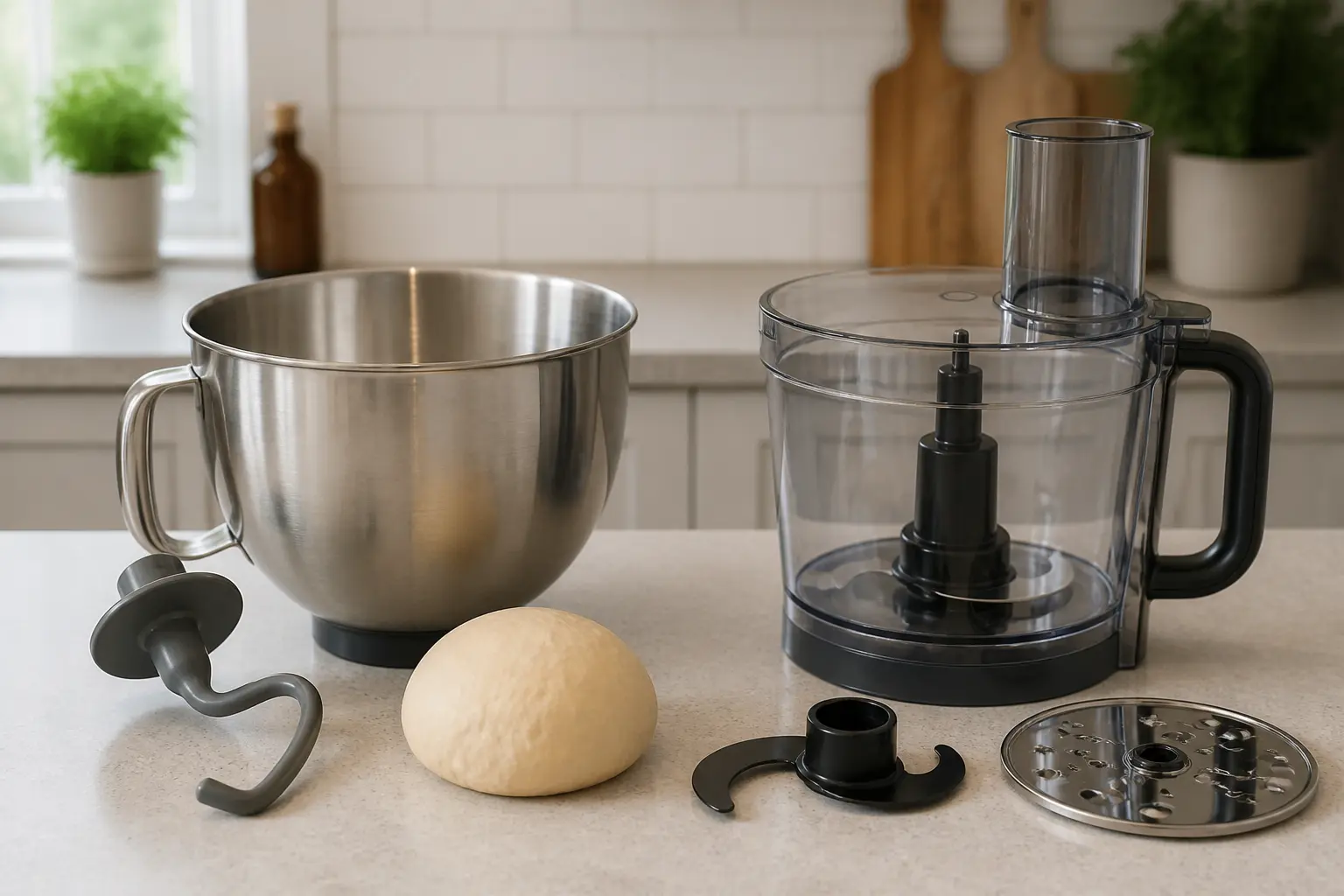
Task-by-Task Comparison
There is genuine overlap, especially once optional tools enter the picture. The table below compares the typical core strengths of each appliance. Always check the included tools on the exact model you are considering.
| Kitchen task | Stand mixer | Food processor | Better choice |
|---|---|---|---|
| Cake batter | Controlled mixing and easy bowl access | Fast, but easier to overmix | Stand mixer |
| Whipping cream or egg whites | Balloon whisk adds volume gradually | Possible only with the right whisk tool | Stand mixer |
| Bread dough | Designed for repeated kneading | Useful for smaller occasional batches if specified | Stand mixer |
| Chopping vegetables | Requires an optional attachment | Core knife-blade task | Food processor |
| Slicing and grating | Requires compatible extra tools | Core disc task on most full-size models | Food processor |
| Breadcrumbs, pesto and dips | Awkward without a blender or processor attachment | Quick in the main bowl or mini bowl | Food processor |
| Shortcrust pastry | Good control with a flat beater | Fast blade method keeps handling brief | Either |
| Hands-free continuous work | Excellent for mixing and kneading | Most jobs finish quickly and need monitoring | Stand mixer |
The table is a starting point rather than a promise about every model. Some processors include dough tools and dual whisks. Some mixers accept food-processing attachments. The important question is not “Can it do this once?” but “Will it do this task well enough, in the quantity I make, with a setup I will actually use?”
We would not buy either appliance to solve a single two-minute job. The value appears when several of your routine tasks line up with the machine’s core design.
Baking: Mixing, Whisking and Kneading
Stand mixers win the baking comparison because they offer control as well as power. Baking mixtures change as ingredients combine, so being able to alter speed, pause, scrape and add ingredients without removing a processor lid is useful.
Cake mixtures and creaming
Creaming butter and sugar is not simply a chopping task. The goal is to incorporate air while building an even mixture. A flat beater works through the bowl repeatedly, while the open design lets you check the sides and base for unmixed pockets.
A processor can make an all-in-one cake mixture quickly, and many people get good results that way. The disadvantage is that its knife blade works fast. A few extra seconds can take a mixture further than intended, particularly after flour is added. For occasional simple cakes, that may be an acceptable compromise. For someone who enjoys adjusting texture and making several components, the stand mixer is easier to manage.
Whisking and aeration
A balloon whisk is built to move through a large volume and introduce air. It suits meringue, whipped cream, marshmallow mixtures and whisked sponges. You can watch the texture change and stop at soft or stiff peaks.
Some processors include a whisk, but you should check what type it is and what quantities the manual permits. A standard knife blade is not a substitute for a balloon whisk. If whisking is one of your main tasks, count the actual supplied whisk rather than assuming the word “mixing” covers it.
Bread and enriched dough
For frequent bread making, choose a stand mixer with a suitable dough capacity. The hook kneads while the bowl contains the dough, and the machine can work for the sustained period the recipe requires. Bowl capacity and maximum flour or dough weight are more useful than bowl litres alone, so check the manual for the model’s stated limits. Our stand mixer bowl-size guide explains why usable capacity changes with the mixture.
A food processor can bring dough together very quickly. Kenwood notes that some processors can handle small quantities of dough, while recommending a stand mixer when bread and cakes are the primary plan. Its food processor selection guide is useful here because it treats dough capability as model- and quantity-dependent rather than universal.
For one occasional pizza dough, a capable processor may be enough. For weekly loaves, brioche or larger batches, the stand mixer is the more convincing long-term choice.
Food Preparation: Chopping, Slicing, Grating and Pureeing
The food processor becomes the clear winner once the job is about cutting ingredients rather than developing a mixture.
Chopping without turning everything to mush
The knife blade can chop onions, herbs, nuts and vegetables quickly, but pulse control matters. Continuous processing moves ingredients from coarse to fine surprisingly fast. Use short pulses, scrape down if necessary and stop before the bowl looks uniformly wet.
A stand mixer’s ordinary bowl tools do not chop. You would need a compatible processor, mincer or chopper attachment, and the result depends on that attachment rather than the mixer itself.
Slicing and grating consistently
Discs give a food processor its strongest everyday advantage. Ingredients pass through a fixed cutting surface, producing more consistent slices or shreds than a knife blade. This is useful for slaws, gratins, salads, grated cheese and batches of vegetables.
Feed-tube width affects how much trimming is required. Disc choice affects thickness. Those details matter more than headline motor wattage for this kind of work. Our food processor buying guide covers those model-level differences separately; this comparison is about deciding whether you need that type of machine at all.
Purées, dips and breadcrumbs
Processors handle pesto, hummus-style dips, breadcrumbs and many thicker purées well because the blade repeatedly pulls ingredients into its path. Small quantities can be more awkward in a large bowl, so a mini bowl or compact chopper can be useful if these are your main jobs.
For smooth liquids, check whether the processor includes a blender and whether that vessel is approved for the temperature involved. A processor bowl is not automatically suitable for hot soup. Follow the appliance instructions rather than relying on the general capability of the product category.
Space, Storage and Cleaning
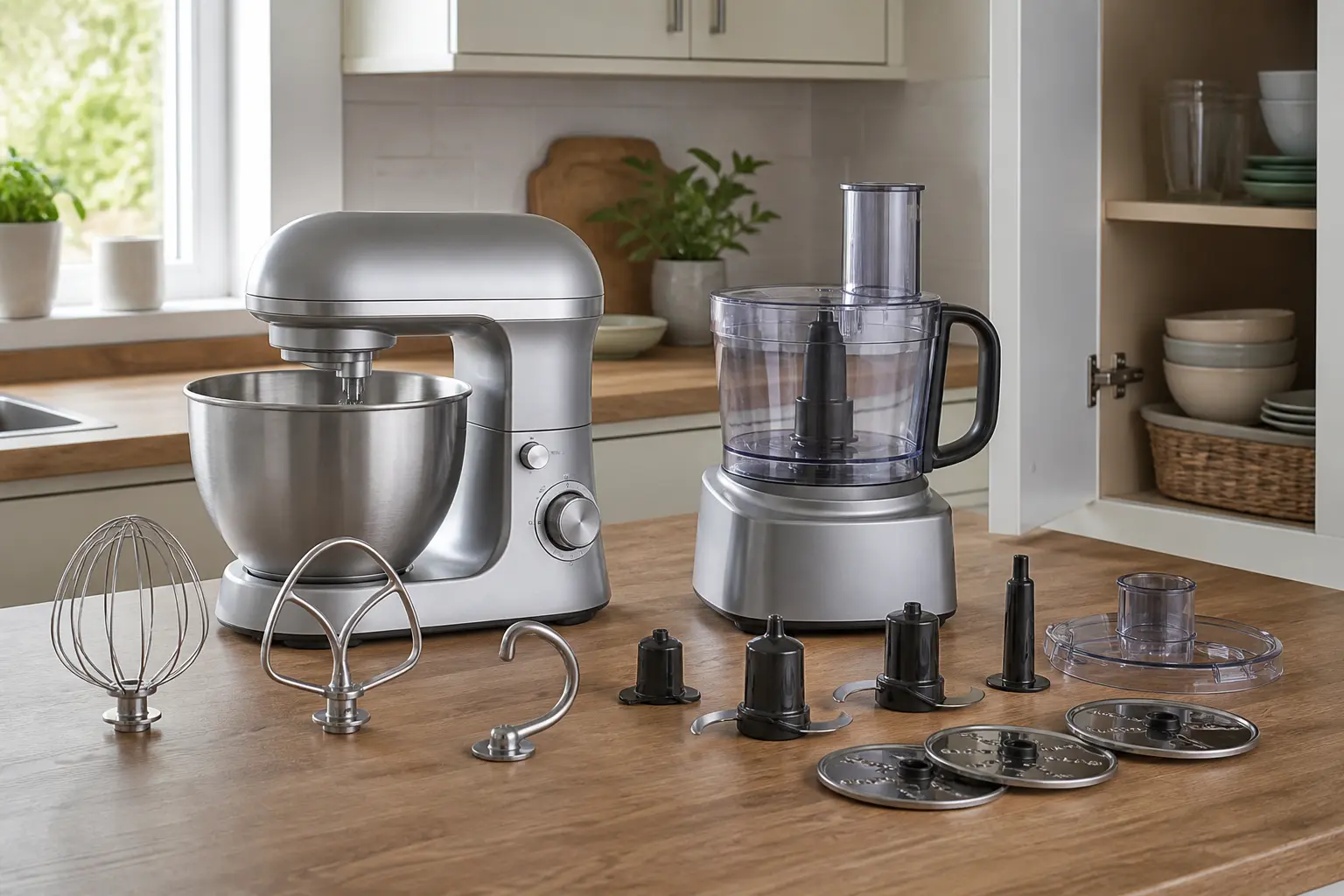
Counter space often decides this comparison before performance does. Measure the appliances in their usable position, including the room needed to lift a mixer head or remove a processor lid.
Worktop footprint
A stand mixer is usually heavy enough that owners prefer to leave it out. That can be convenient for frequent baking but hard to justify if it is used once a month. Check height beneath wall cupboards as well as width and depth. A tilt-head mixer needs clearance above it; a bowl-lift design needs space around the bowl mechanism.
A processor base may occupy less worktop, but the bowl, lid, feed tube, pusher, blade and discs still need a home. Calling it compact while filling a cupboard with loose accessories is creative accounting.
Before buying, mark the footprint on your worktop with paper or masking tape and identify where every separate part will go. It is a boring five-minute exercise that prevents a surprisingly expensive storage problem.
Washing up
A basic mixer job may leave one bowl and one tool to wash. Sticky dough around a hook takes effort, but there are relatively few parts. Splash guards add another item, and dried batter in joints is easier to avoid than remove.
A processor often creates more pieces: bowl, lid, pusher, spindle, blade or disc and sometimes a separate accessory box. Many parts may be dishwasher-safe, but sharp blades still need careful handling and dry storage. Check the manual rather than assuming every clear plastic component belongs in a hot dishwasher cycle.
The practical winner depends on frequency. A processor that saves ten minutes of slicing can justify several washable parts. Setting it up to chop half an onion probably cannot. A mixer earns its washing-up burden when it replaces sustained whisking or kneading.
Price, Attachments and the Cost of Overlap
You can find both appliance types at budget, mid-range and premium prices. The more useful comparison is the cost of getting the functions you will genuinely use.
Buy the core machine first
A stand mixer should be judged first as a mixer. A food processor should be judged first as a processor. If one performs its core job badly, an impressive accessory catalogue does not rescue it.
Optional attachments can be worthwhile when they share a powerful motor and save space, but check four things before counting them as replacements:
- Compatibility: attachment hubs and model families are not universal.
- What is included: a product photograph may show tools sold separately.
- Setup time: an attachment that lives at the back of a cupboard may rarely be used.
- Total cost: a base appliance plus several accessories can exceed the price of two simpler machines.
Our stand mixer attachment guide explains the common tool types and the jobs they are intended to perform. Treat it as a compatibility checklist, not a reason to collect every accessory.
When owning both makes sense
Owning both is sensible for someone who bakes frequently and also prepares large quantities of vegetables, cheese, pastry or dips. The appliances can work in parallel: dough kneads in the mixer while the processor chops a filling. That is a real workflow benefit, not mere duplication.
It makes less sense when both machines would be used occasionally. In that case, choose the appliance that removes your most disliked recurring job. You can whisk with a hand mixer, grate with a box grater and knead by hand when necessary. The right appliance is the one that changes what you regularly cook, not the one with the longest specification sheet.
If your uncertainty is really between a handheld beater and a full mixer, read our hand mixer vs stand mixer comparison. A hand mixer occupies a different middle ground and may be the sensible answer for occasional cakes in a small kitchen.
Which Should You Buy?
Buy a stand mixer if baking is the reason you want help. It is the better tool for creaming, whisking, controlled mixing and repeated dough work. It also offers the most useful form of hands-free operation: the machine continues a sustained job while you weigh, shape or clean.
Buy a food processor if preparation is the reason you want help. It is faster for chopping, slicing, grating, breadcrumbs, dips and many pastry jobs. For cooks who prepare fresh meals more often than they bake, it will usually be used more frequently.
Choose a stand mixer for:
- Weekly bread, cakes, pastry or meringue.
- Larger or repeated dough batches within the stated model limit.
- Cooks who want an open bowl and gradual control.
- People happy to dedicate permanent worktop space to baking.
Choose a food processor for:
- Regular vegetable chopping, slicing and grating.
- Fast pastry, breadcrumbs, pesto and thicker sauces.
- Cooks who value short preparation jobs over long mixing jobs.
- Kitchens where one base and a stored set of tools fit better.
Consider owning both if each appliance would tackle several weekly tasks and you have a planned storage position. Do not buy both merely because their features overlap; buy both when their different strengths will be used.
Our final verdict is simple: the keen baker should buy the stand mixer, while the everyday cook who wants to reduce knife-and-grater work should buy the food processor. If you still cannot decide, list the ten jobs you most want to avoid. Whichever machine wins more of those jobs is the one your kitchen needs.
Frequently Asked Questions
Can a food processor replace a stand mixer for baking?
A food processor can handle some cake mixtures, pastry and small dough quantities when the manufacturer allows it. It does not offer the same open-bowl control, gradual whisking or sustained dough-focused workflow as a stand mixer. It is a reasonable compromise for occasional simple baking, not a direct replacement for a keen baker.
Can a stand mixer chop vegetables?
Not with its standard beater, whisk or dough hook. Some stand mixers accept compatible slicer, grater, mincer or food-processor attachments, but these vary by brand and model. Check compatibility, included parts and total cost before assuming a mixer can cover processor tasks.
Which is better for bread dough?
A suitable stand mixer is generally better for regular bread making because its dough hook and bowl are designed for sustained kneading. Some food processors can make small dough batches quickly, but you must follow their stated flour, dough and running-time limits.
Which appliance is easier to clean?
For a basic task, a stand mixer usually leaves fewer parts: a bowl and one tool. A food processor may involve a bowl, lid, pusher, spindle and blade or disc. The processor can still save time overall when it replaces a lengthy chopping or grating job.
Do I need both a stand mixer and a food processor?
Only if you regularly use the distinct strengths of both. Frequent bakers who also prepare large amounts of vegetables or grated ingredients can benefit from owning both. Occasional cooks are usually better served by choosing the machine that solves their most common preparation problem.
Is a stand mixer or food processor better for a small kitchen?
Neither automatically wins. A stand mixer is heavy and often lives on the worktop; a processor may have a smaller base but more loose accessories. Measure the usable footprint and allocate cupboard space for every part before buying.