The KitchenAid Artisan 5KSM125 is the best stand mixer for most UK home bakers. It is sturdy, simple to use and supported by a broad attachment range. Choose the Kenwood Chef XL for larger batches, Kenwood Go when cupboard space is tight, Bosch Series 2 when bundled food-preparation tools matter, or Tower when price is the main constraint.
Our top 5 picks

Best overall — KitchenAid Artisan 5KSM125
A 4.8L all-rounder for regular baking. Check the linked Almond Cream finish’s delivery estimate before ordering.

Best for larger batches — Kenwood Chef XL KVL4100W
Its 6.7L bowl gives doubled recipes and family baking more room.

Best compact — Kenwood Go
A 4L mixer that is easier to fit beneath cupboards or put away.

Best multifunction package — Bosch Series 2 MUMS2VM40G
Mixing tools plus food-preparation accessories in one package.
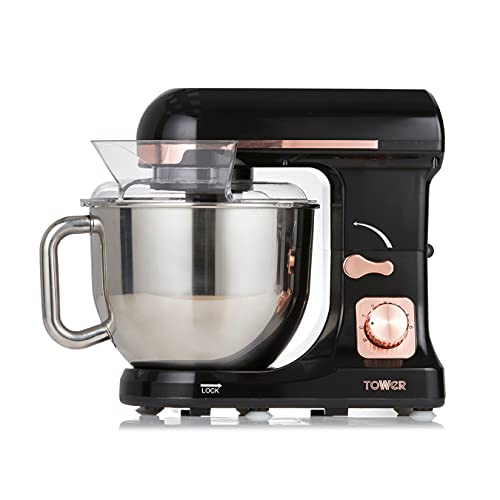
Best budget — Tower T12033RG
Core mixing tools and a 5L bowl for occasional baking.
In this guide
- Comparison at a glance
- The five best stand mixers
- Head-to-head recommendation
- How to choose bowl size and tools
- Stand mixer vs hand mixer
- How we chose
- The bottom line
- Frequently asked questions
Comparison at a glance
| Mixer | Best for | Bowl | Motor and speeds | Main trade-off |
|---|---|---|---|---|
| KitchenAid Artisan 5KSM125 | Best overall | 4.8L | 300W, 10 speeds | Heavy and needs permanent worktop space |
| Kenwood Chef XL KVL4100W | Best large capacity | 6.7L | 1200W, variable speed | Large footprint and fewer premium extras than Chef Baker models |
| Kenwood Go | Best compact | 4L | 800W, 6 speeds + pulse | Smaller bowl and fewer expansion options |
| Bosch Series 2 MUMS2VM40G | Best multifunction package | 3.8L | 900W, 7 speeds + pulse | More food-processor parts to store |
| Tower T12033RG | Best budget | 5L | 1000W, 6 speeds + pulse | Lighter construction and less suited to demanding frequent dough work |
The best choice is not the mixer with the largest motor number. Start with the recipes you make most often, then check capacity and storage. A heavy machine that stays on the worktop is often more useful than a feature-packed model that must be lifted out of a cupboard for every cake.
The five best stand mixers
1. KitchenAid Artisan 5KSM125: best overall
The Artisan wins on balance rather than a single headline figure. Its 4.8-litre bowl suits everyday cakes, biscuits, meringue and typical home bread batches, while ten speeds cover folding, beating and whipping. The direct-drive design and substantial metal body help it stay planted, though its roughly 10kg weight makes permanent worktop space desirable.
The box includes the stainless-steel bowl, flat beater, dough hook and wire whisk. The front hub accepts optional KitchenAid attachments, but these are separate purchases. Its 300W rating should not be compared directly with higher-wattage belt-driven machines as proof of weaker performance; follow KitchenAid’s recipe and load guidance instead.
- Buy it if: you bake regularly and want a stable, well-supported all-rounder.
- Skip it if: you need a very large bowl or must lift the mixer in and out of storage.
- Main compromise: excellent everyday design and attachment choice at a premium price.
Check the delivery estimate for the linked Almond Cream finish before ordering; other colours can have different dispatch windows.
2. Kenwood Chef XL KVL4100W: best large-capacity option
The Chef XL is the practical choice for larger households and batch bakers. Its 6.7-litre bowl gives considerably more working room than the KitchenAid, while variable speed and pulse provide control from gentle starts to faster whisking. The supplied K-beater, whisk and dough tool cover the core mixing jobs without making the package unnecessarily complicated.
This KVL4100W is a Chef XL rather than the more expensive Chef Baker XL, so do not expect integrated scales or a second bowl. Optional Kenwood attachments connect through the relevant outlets, but compatibility should be checked against the exact model and attachment code before purchase. The larger bowl does not mean every recipe should be scaled to its rim.
- Buy it if: you regularly make larger cake, bread or family batches.
- Skip it if: your kitchen is small or you mainly make one small cake at a time.
- Main compromise: generous capacity and sensible tools in a sizeable appliance.
3. Kenwood Go: best compact option
The Kenwood Go is only about 30cm high and has a carry handle, making it easier to store than a traditional full-height Chef or Artisan. Its 4-litre bowl, six speeds and pulse setting cover normal cake mixing, whisking and smaller dough jobs. The rotating splashguard also makes the machine easier to use from different positions on a tight worktop.
It includes a K-beater, whisk and dough tool, plus an integrated measuring spoon. The bowl is smaller than the Artisan’s and much smaller than the Chef XL’s, so it suits moderate batches rather than bulk baking. Its compact shape is the selling point; buyers wanting a large attachment ecosystem should look elsewhere.
- Buy it if: storage space matters more than maximum bowl capacity.
- Skip it if: you regularly double recipes or want a broad powered-attachment system.
- Main compromise: useful capability in a compact body, with less batch room.
4. Bosch Series 2 MUMS2VM40G: best multifunction package
The Bosch is the strongest option here when mixing is only part of the job. The exact MUMS2VM40G package includes the 3.8-litre bowl and core pastry tools alongside food-processing accessories, allowing slicing, grating and blending without buying separate appliances. Seven speeds and pulse give more adjustment than many entry-level packages.
Its 3D planetary mixing action is designed to reach around the bowl, but the system’s real appeal is versatility. The downside is storage: bowls, discs, blender parts and tools take space even when the motor unit is compact. Check the precise box contents on delivery and use each accessory only as described in the model manual.
- Buy it if: one motor base replacing several preparation appliances is useful.
- Skip it if: you only want a simple, heavy stand mixer for frequent baking.
- Main compromise: broad package versatility with more components to organise.
5. Tower T12033RG: best budget option
Tower’s T12033RG offers the basic stand-mixer format at the budget end of this shortlist. The 5-litre stainless-steel bowl, six speeds, pulse setting and supplied beater, whisk and dough hook cover cake batter, cream, eggs and occasional dough. The tilt-head design provides direct access to the bowl, while suction feet help keep the lighter machine in place.
A budget machine is best treated as an occasional-baking tool rather than a cheaper equivalent to a heavy metal mixer. Keep to the manual’s batch and running-time limits, stop if the machine strains and avoid using wattage alone to infer dough capacity. It is a good entry point when use will be light and expectations are realistic.
- Buy it if: you want basic hands-free mixing for occasional baking at low cost.
- Skip it if: you knead stiff dough frequently or expect a large attachment range.
- Main compromise: useful capacity and core tools with lighter construction.
Head-to-head: which stand mixer should you buy?
Choose the KitchenAid Artisan if you want the most versatile all-round recommendation here. It suits frequent home baking, has simple controls and offers the broadest optional attachment ecosystem in this group. Choose the Kenwood Chef XL when bowl space matters more than compactness, particularly for larger family batches.
The Kenwood Go is the best answer for a smaller kitchen because its low height and carry handle address the practical problem of storage. Bosch makes sense when you will genuinely use the slicing, grating and blending accessories. Tower is the budget choice for lighter, occasional work; it should not be bought on the assumption that a four-figure wattage makes it equivalent to a heavier premium machine.
For most buyers, bowl size and where the mixer will live decide more than colour or maximum speed. Measure beneath wall cupboards with the head raised where relevant, and allow space to remove the bowl. Our stand-mixer bowl size guide explains why usable capacity is not the same as filling a bowl to the top.
Also think about cleanup before choosing. A polished machine may look ideal on the worktop, but a heavy bowl, awkward splashguard or collection of hand-wash-only tools can become irritating after a quick weekday bake. Check which components are dishwasher-safe in the exact manual, whether the bowl has a handle, and whether the beater can be adjusted if ingredients collect at the bottom. These details affect daily use more than a rarely used top speed.
How to choose bowl size, tools and attachments
Match the bowl to normal batches
A 4 to 5-litre bowl is enough for many UK home recipes. Larger bowls help with doubled cake mixtures and bigger dough batches, but can be less convenient for one egg white or a small amount of cream. Manufacturer maximums are limits under specified conditions, not a recommendation to run every recipe at full load.
If bread is the priority, check the manual’s flour and dough limits for the exact model. Hydration, flour type and mixing time all change the load on a machine. Our stand-mixer bread guide covers method, while stand-mixer bread recipes shows why different doughs behave differently.
Check included tools and future attachments
A whisk, flat beater and dough hook are the useful minimum. Splashguards are helpful when adding flour, but designs vary. Food processors, mincers, pasta rollers and blenders may use powered hubs; compatibility is brand- and model-specific. Never assume an older Kenwood attachment or a similarly named Bosch accessory fits the current machine.
Buy attachments for jobs you already do, not hypothetical ones. A pasta roller can earn cupboard space for a weekly pasta maker; a citrus press used twice a year probably will not. See our stand-mixer attachments guide before building a package.
Do not rank mixers by watts alone
Electrical input, motor design and gearing differ, so wattage is not a cross-brand performance score. Slow-start control can matter more in daily use because it reduces flour clouds, while stable speed under load matters more than a high maximum. Follow the precise model’s instructions, batch limits and rest periods.
Weight is also a trade-off. A heavy mixer is usually steadier but awkward to move. A light machine is easier to store but may need careful positioning and smaller batches. Noise varies by speed, load and worktop, so fixed decibel-style claims without consistent measurement are not useful buying evidence.
Stand mixer vs hand mixer
A hand mixer is cheaper, smaller and perfectly suitable for cream, egg whites and many cake batters. A stand mixer becomes worthwhile when hands-free mixing, longer kneading, heavier mixtures or repeat batches justify the worktop space. It also lets you add ingredients while the tool continues moving.
Do not buy a stand mixer simply because it is the expected next step in baking. If you bake once a month and never make dough, a good hand mixer may be the better tool. If you bake weekly, struggle to hold a hand mixer for long periods or want powered attachments, a stand mixer is easier to justify. The NHS advises modifying activities and seeking advice where persistent pain or repetitive strain symptoms are a concern; a mixer can reduce sustained holding, but it is not a medical treatment. NHS guidance on repetitive strain injury provides the appropriate health context.
For dedicated bread making with minimal handling, also compare a bread maker. A bread maker handles mixing, proving and baking, whereas a stand mixer gives more control over shaping and oven baking.
How we chose
We compared the exact UK models by bowl capacity, supplied tools, speed control, footprint, weight, attachment options and the jobs each machine is designed to handle. Wattage is included as a specification, but it is not used as a direct ranking of mixing strength because gearing, planetary action, motor design and recommended batch limits also matter.
This is a specification-led guide based on current exact-product information and manufacturer documentation. We did not conduct hands-on tests or assess long-term durability. Package contents can vary by model suffix, so every recommendation refers to the named version rather than assuming that accessories from a related mixer are included. We also prioritised useful differences over decorative finishes or short-lived price reductions.
The bottom line
The KitchenAid Artisan 5KSM125 is the best stand mixer for most home bakers in this comparison. Pick the Kenwood Chef XL for larger batches, Kenwood Go for tight storage, Bosch Series 2 for a multifunction package, or Tower when occasional use and a low purchase price matter most.
Frequently Asked Questions
Which stand mixer is best overall?
The KitchenAid Artisan 5KSM125 is the best all-round choice here for regular home baking, with a 4.8-litre bowl, stable construction and broad optional attachment support.
What size stand mixer is best for home baking?
A bowl around 4 to 5 litres suits many everyday cake, biscuit and single-loaf recipes. Choose a larger bowl if you regularly double recipes, while checking the exact model’s recommended loads.
Is a higher-wattage stand mixer always better?
No. Wattage is not a direct cross-brand measure of mixing strength. Motor design, gearing, tool movement, speed control and recommended batch limits all affect performance.
Can every stand mixer knead bread dough?
Many can knead dough, but suitable quantity and mixing time vary. Follow the exact model manual and reduce the load if the machine strains, moves excessively or exceeds its stated limits.
Are KitchenAid attachments compatible with every mixer?
KitchenAid hub attachments fit many tilt-head and bowl-lift stand mixers, but bowls, beaters and some accessories are model-specific. Confirm compatibility using the exact mixer and accessory codes.
Do I need a stand mixer or will a hand mixer do?
A hand mixer is enough for occasional cakes, cream and egg whites. A stand mixer is more useful for frequent baking, dough, longer mixing and hands-free work, provided you have the storage space.