A kettle is still the better buy for most UK kitchens, but a hot water dispenser wins if you mainly make one mug at a time, struggle lifting a full kettle, or keep reboiling more water than you need. The kettle vs hot water dispenser decision comes down to habits, not marketing: how many drinks you make, how fussy you are about water temperature, and whether convenience is worth giving up some flexibility.
In This Article
- Quick Verdict: Kettle vs Hot Water Dispenser
- What Each Appliance Actually Does
- Running Costs and Wasted Water
- Speed, Capacity and Drink Quality
- Accessibility, Safety and Everyday Use
- Space, Limescale and Cleaning
- What to Buy at Each Budget
- Which One Should You Choose?
- Frequently Asked Questions
Quick Verdict: Kettle vs Hot Water Dispenser
For most homes, I would buy a good variable-temperature kettle before a hot water dispenser. It is cheaper, more flexible, easier to clean, and better for cooking tasks where you need a panful of boiling water. A decent Russell Hobbs, Bosch, Morphy Richards or Kenwood kettle costs about £25-£60, and even nicer temperature-control models from Sage, KitchenAid or Dualit usually sit around £70-£150.
A hot water dispenser makes more sense if your normal use is tea, instant coffee, baby bottle cooling routines, instant noodles, gravy granules or one-person working-from-home drinks. It gives you measured water quickly and reduces the habit of boiling 1.7 litres for one mug. The best-known Breville HotCup models are typically about £49.99-£60, with larger or variable-dispense versions around £55-£90 at Argos, Amazon UK and Currys.
My short answer
Choose a kettle if you:
- Cook with boiling water for pasta, rice, vegetables or stock.
- Make several drinks at once for family, guests or builders.
- Want temperature control for green tea, pour-over coffee or baby formula prep.
- Have hard water and want the easiest possible descaling job.
Choose a hot water dispenser if you:
- Mainly make single mugs and hate waiting for the kettle.
- Overfill the kettle constantly and want the appliance to stop you wasting water.
- Find lifting a kettle difficult because of arthritis, grip issues or reduced strength.
- Have a small office or drinks station where measured hot water is useful.
That is the real split. A hot water dispenser is not a magic energy-saving machine. It is a habit-control machine.
What Each Appliance Actually Does
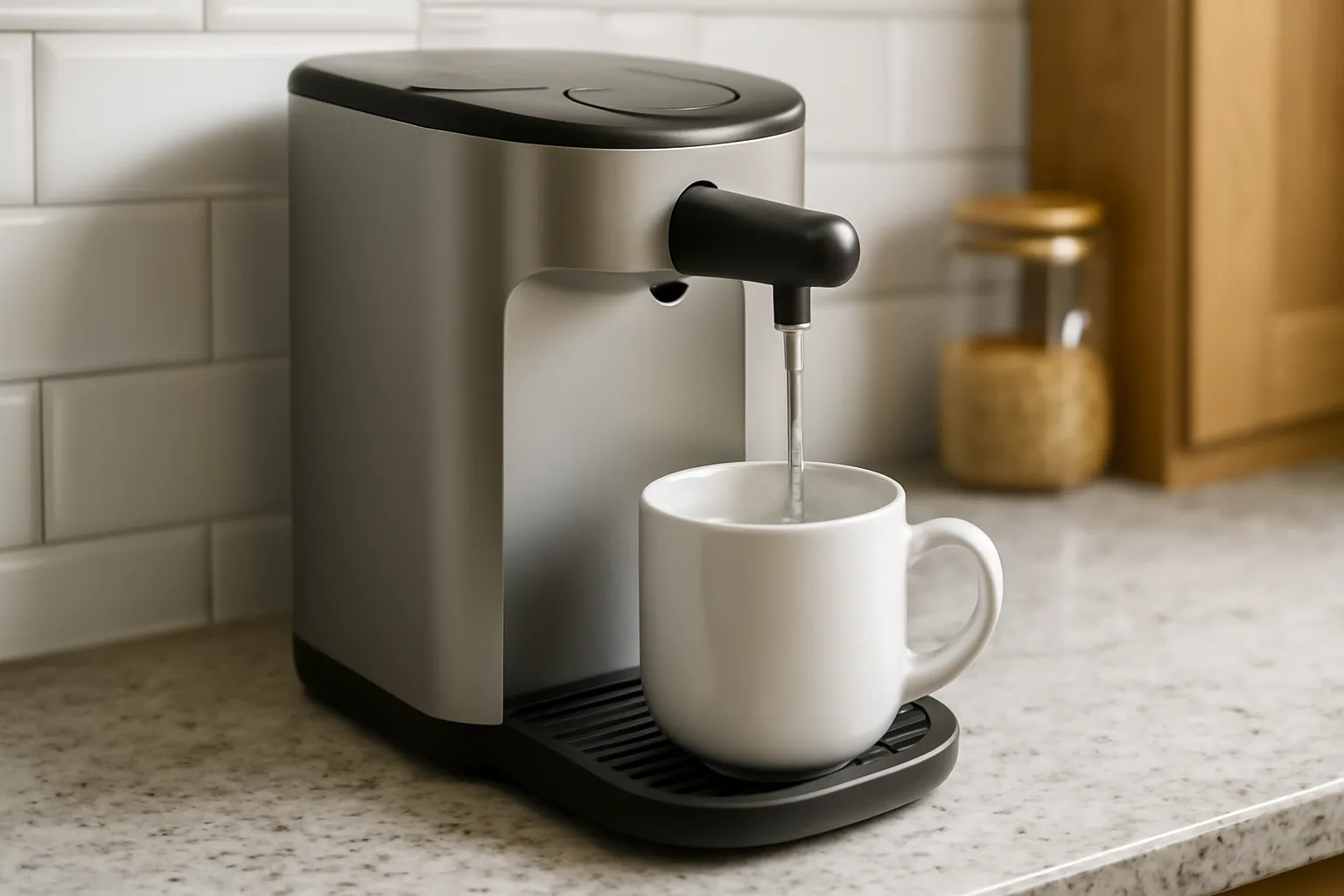
A kettle heats a tank of water and lets you pour whatever amount you want. A hot water dispenser heats and releases a measured amount, usually one cup at a time, through a spout.
Standard electric kettles
Most UK electric kettles are simple 2.2-3kW appliances with a 1.5-1.7 litre capacity. You fill them, press the switch, wait for the boil, and pour. Basic models from Argos and supermarkets can be £15-£25. Better stainless steel or glass kettles from Russell Hobbs, Bosch, Morphy Richards and Kenwood are commonly £30-£70. Premium models with temperature settings can be £80-£150.
The big advantage is flexibility. One mug, four mugs, a saucepan of water for spaghetti, preheating a teapot, rinsing a cafetiere, loosening a jar label: a kettle does all of it. That is why it survives in almost every kitchen even when people own pod machines, bean-to-cup machines and air fryers.
One-cup hot water dispensers
One-cup dispensers, such as the Breville HotCup range, heat and dispense a cup without you lifting a kettle. The Breville VKJ142 HotCup is listed by Breville at £49.99 and dispenses a 250ml cup size. Argos currently lists the Breville VKT124 at £60 with 1.7 litres/8-cup capacity and 3kW power, while the Breville VKJ318 is around £54.99 with a 2-litre tank.
These are best for mugs. They are less good when you need 800ml for a pan, or when your favourite mug is not close to the dispense size. Some models have manual stop or variable dispense; cheaper ones may be more fixed.
Tank-style instant hot water machines
There is a bigger category above one-cup dispensers: countertop boilers, office urns, and boiling water taps. A 5-litre catering-style boiler can be £70-£150, while boiling water taps can run from about £300 to £1,200+ before fitting. Those are different decisions. This article is mainly about a normal kettle versus a domestic countertop hot water dispenser.
If you are building a new kitchen, a boiling water tap is a design and plumbing decision. For most renters and normal households, the choice is kettle or plug-in dispenser.
Running Costs and Wasted Water
The cheapest hot water is the water you do not heat. That sounds painfully obvious, but it is the main point people miss.
The NI Direct government energy-efficiency advice says to use only the amount of water you need when boiling the kettle. That does not mean every hot water dispenser is cheaper to run. It means waste matters.
Why kettles waste energy
A kettle wastes energy when you overfill it. If you boil 1.2 litres for a 250ml mug, you have heated almost a litre for no reason. Do that several times a day and the waste adds up.
Based on a typical UK electricity unit rate around 24-28p/kWh, boiling 250ml in a 3kW kettle might cost roughly 1p or less, while boiling a full 1.7-litre kettle can be several pence. The exact figure depends on starting water temperature, kettle efficiency and tariff, but the direction is clear: water volume matters more than the badge on the appliance.
Why dispensers can help
A hot water dispenser can help because it rations the amount by design. If it dispenses 250ml, you heat roughly a mugful. That is useful for people who know they overfill kettles. Based on owner feedback on one-cup machines, the practical saving is often behavioural: fewer reboils, less leftover water, and fewer full-kettle boils for one drink.
The downside is that some dispensers are not truly instant from cold for every model and every pour. Some heat in bursts, some dispense slightly cooler water than a fresh kettle, and some users run a second cycle if the first cup is not hot enough. If you do that, the energy argument weakens quickly.
Keep-warm models are different
Avoid assuming every dispenser is efficient. A machine that keeps several litres hot all day is different from a one-cup machine that heats on demand. In a busy office, keeping water hot can make sense. In a two-person house making four drinks a day, it can be wasteful.
For a normal home, the running-cost winner is simple: boil only what you need, whichever appliance you use.
Speed, Capacity and Drink Quality
Hot water dispensers feel quicker because they remove the fill, wait, lift and pour routine. Kettles feel slower, but they are often faster when you need several cups or a larger amount.
One mug
For one mug of instant coffee or standard tea, a dispenser is very convenient. Press the button, wait for the cup, done. A Breville-style one-cup machine can feel ideal beside a home-office desk or in a small kitchen where one person makes drinks through the day.
A kettle can still be quick if it has a minimum fill line around 250-300ml and you actually use it. The problem is that many people do not. They fill from the tap for a second too long, then reboil the same water later. Ask me how I know.
Several mugs
For three or four mugs, a kettle usually wins. You boil once and pour. With a one-cup dispenser, you may wait for each mug, and cheaper fixed-dose machines can make cup sizes awkward. A 250ml dispense is fine for a standard mug, short for a large insulated cup, and too much for a small teacup.
If you regularly make tea for a family breakfast, the dispenser will annoy you. The kettle is boring, but boring works.
Tea and coffee quality
For black tea, many people want freshly boiled water close to 100°C. Some hot water dispensers are hot enough for everyday tea, but fussy tea drinkers may notice if the cup is slightly cooler. For green tea and some coffees, cooler water can be useful, but a variable-temperature kettle does that more accurately.
For coffee, the appliance depends on the method. Instant coffee is fine with either. Cafetiere and pour-over drinkers are better served by a kettle, ideally a gooseneck or temperature-control model. If you are already comparing coffee gear, our guides to coffee machine types, choosing the right coffee machine and filter coffee machines will be more useful than a dispenser.
Accessibility, Safety and Everyday Use
This is where hot water dispensers earn their keep. A full kettle is awkward if your hands hurt, your grip is weak, or you are worried about spilling boiling water.
Lifting and pouring
A 1.7-litre kettle weighs roughly 1.7kg plus the kettle body when full. That does not sound huge until you are pouring at arm’s length with steam in your face. For someone with arthritis, tremor, wrist pain or reduced strength, a dispenser can be the more sensible choice.
The Breville VKT124 page at Argos specifically positions it as useful for people who struggle with heavy kettles, and that matches the real reason many households buy one. This is not just a gadget. For the right person, it removes a daily scald risk.
Scald and drip risks
Dispensers introduce their own risks. The cup has to sit correctly under the spout, the drip tray needs emptying, and children should not be able to press the button. Some models splash if the cup is too shallow or too far below the spout.
Kettles have risks too: trailing cords, overfilled spouts, loose lids, and wobbly bases. A £25 kettle with a secure lid, clear water window and comfortable handle can be safer than a stylish glass model that gets too hot to touch.
Baby formula caution
Do not buy a hot water dispenser assuming it solves baby formula preparation. Formula guidance can be specific about water temperature and timing, and many dispensers are designed for drinks rather than controlled formula prep. If baby feeding is the main reason, check current NHS/manufacturer guidance for formula preparation and consider a purpose-made prep routine rather than improvising around a drinks appliance.
Space, Limescale and Cleaning
A kettle has one job and a small footprint. A dispenser is not huge, but it uses more permanent counter space because it needs room under the spout and above the tank for refilling.
Counter space
A kettle base can tuck into a corner. A dispenser needs front access, mug clearance and a drip tray. The Breville VKT124 is listed at H24.5 x W24.5 x D17.8cm, while the VKJ318 is H28.6 x W27.5 x D16.3cm. That is still compact, but not invisible.
If you already have an air fryer, toaster, pod machine and blender fighting for space, be honest. Another countertop appliance may not be worth it. Our guide to kitchen gadgets worth the drawer space is basically a warning against buying appliances that only solve a mild irritation.
Limescale
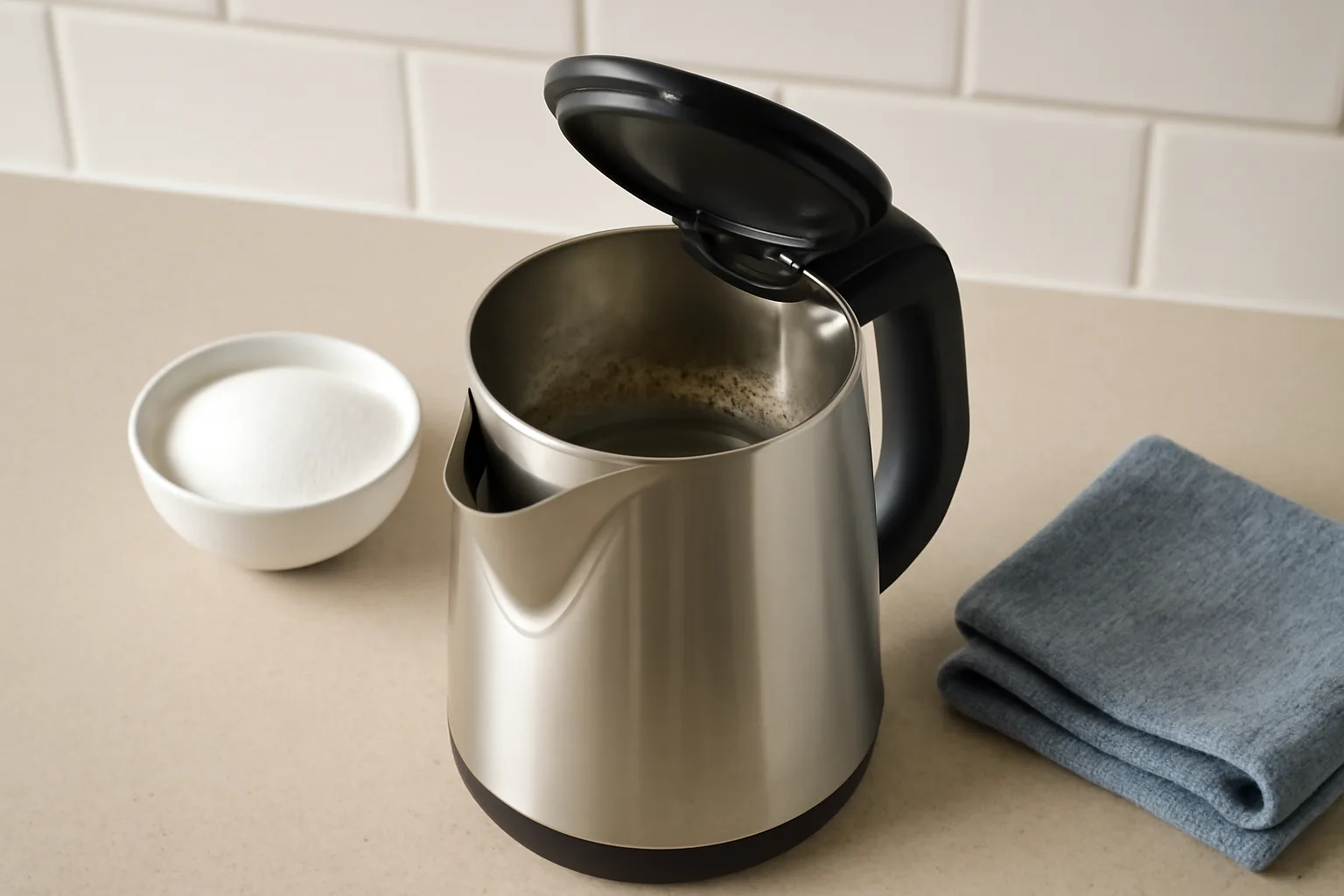
Hard water is the dull villain in this decision. Kettles descale easily with citric acid or white vinegar. Many dispensers also descale, but the route through internal pipework can be less forgiving if you ignore it.
If you live in a hard-water area, budget for descaler. Citric acid powder is about £3-£6 for a bag, and branded kettle descaler sachets are usually £2-£5. A filter kettle can be about £35-£70, but replacement filters are a running cost at roughly £15-£30 for multipacks.
Cleaning routine
A kettle cleaning routine is simple:
- Empty old water. Do not keep topping up stale water for days.
- Descale monthly in hard-water areas. Use citric acid or a kettle-safe descaler.
- Wipe the base and handle. Sticky tea and coffee splashes make appliances feel grim fast.
- Check the lid and spout filter. A loose lid or blocked filter makes pouring worse.
For a dispenser, add the drip tray, spout and tank to that list. It is not hard, but it is more bits.
What to Buy at Each Budget
Do not overbuy. The best choice is the appliance that matches your actual hot-water pattern, not the one that looks clever on a product page.
Under £30
Buy a kettle. At this price, hot water dispensers are usually either unavailable, tiny, or from brands I would not choose for daily boiling water.
Good budget kettle options include:
- Argos Cookworks or supermarket own-brand kettle: about £15-£25, fine for basic use.
- Russell Hobbs plastic kettle: often £20-£35 at Argos, Currys or Amazon UK.
- Morphy Richards basic kettle: commonly £25-£40 depending on finish.
Look for a clear water gauge, removable limescale filter and minimum-fill mark. Fancy lighting is not a feature I would pay for.
£40-£70
This is the real comparison zone. You can buy a better kettle or an entry-level hot water dispenser.
My picks would be:
- Breville VKJ142 HotCup: about £49.99 direct from Breville; good if you want fixed one-cup dispensing.
- Breville VKJ318 HotCup: about £54.99 at Argos when discounted; larger 2-litre tank and a familiar HotCup design.
- Breville VKT124 HotCup: about £60 at Argos; 1.7-litre tank, 3kW power and manual stop control.
- Bosch or Russell Hobbs kettle: about £40-£70; better all-rounder if you still cook with boiling water.
If I were buying for my own kitchen, I would choose the better kettle unless there was an accessibility reason. For a home-office corner, I would consider the Breville HotCup.
£80-£150
At this level, a variable-temperature kettle becomes more attractive. Sage, KitchenAid, Dualit and Cuisinart models can sit in this range, especially if you want 80°C, 90°C and 100°C settings for tea and coffee.
Larger hot water dispensers and urn-style boilers also appear here, but they are better for offices, village halls or big families who make repeated drinks. For a normal kitchen, a premium kettle is usually the nicer long-term buy.
£300+
This is boiling-water-tap territory. Quooker, Franke, Grohe and similar systems can cost hundreds or over £1,000 once tanks, filters and fitting are included. They are brilliant in some kitchens, but they are not a like-for-like replacement for a £50 kettle.
Treat a boiling water tap as part of a kitchen renovation, not a casual upgrade. If you are also reviewing other kitchen equipment choices, our guides to induction vs gas vs electric hobs and meal prep equipment may help you think about the whole counter setup.
Which One Should You Choose?
Most households should choose a kettle. It is cheaper, more flexible, and less fussy. Buy a model with a visible water gauge, comfortable handle and minimum-fill mark, then train yourself to boil only what you need.
Choose a hot water dispenser if one of these is true:
- You live alone or work from home alone and make single drinks all day.
- You regularly overfill the kettle and want measured dispensing to force better habits.
- You struggle lifting or pouring and want to reduce scald risk.
- You run a small office drinks station where convenience matters more than perfect tea technique.
The mistake is buying a dispenser because it sounds more modern. It is not automatically better. It is better for a narrower job.
My final answer: buy a £40-£70 kettle for the average kitchen, a £50-£70 Breville HotCup-style dispenser for one-cup convenience or accessibility, and a variable-temperature kettle if tea and coffee quality matter more than speed.
Frequently Asked Questions
Is a hot water dispenser cheaper to run than a kettle? It can be cheaper if it stops you overfilling and reboiling the kettle. If you already boil only one mug of water, the saving is likely to be small. The habit matters more than the appliance.
Does water from a hot water dispenser taste different? It can, especially in hard-water areas or if the dispenser needs descaling. A clean kettle and a clean dispenser should both taste fine, but tea drinkers may prefer a freshly boiled kettle.
Can a hot water dispenser replace a kettle completely? For some people, yes. For most kitchens, no. A dispenser is weaker for cooking, filling pans, preheating teapots and serving several mugs quickly.
What is the best hot water dispenser for most homes? A Breville HotCup model is the safest mainstream starting point, usually around £50-£70. Choose variable dispense if your mugs are different sizes.
Should I buy a boiling water tap instead? Only if you are already planning a kitchen upgrade and have the budget for the tap, tank, filter and fitting. It is convenient, but it is not the value choice compared with a kettle.
What is the biggest mistake when buying one? Buying for the kitchen you imagine rather than the drinks you actually make. If you make four mugs at once, buy a kettle. If you make one mug ten times a day, a dispenser starts to make sense.