You’re scrolling through Currys at midnight, half a dozen tabs open, each one showing a different air fryer that looks suspiciously like all the others. One’s got a digital screen, another claims to be “extra crispy technology,” and there’s a dual-basket model that costs more than your microwave and toaster combined. You just want something that makes decent chips without deep-frying them, but somehow choosing an air fryer has become a research project.
I’ve been through this exact process twice — once when I bought my first budget basket model about three years ago, and again when I upgraded to a dual-zone unit last year. The good news is that once you understand a few key differences, the choice becomes much clearer. The bad news is that manufacturers are brilliant at dressing up minor features as major selling points, and most of those flashy extras aren’t worth paying for.
This guide cuts through the noise. I’ll walk you through the types of air fryers available in the UK right now, explain which features actually matter in a real kitchen, and give you specific recommendations at every price point. If you’ve already narrowed your options, our best air fryers 2026 roundup ranks the top models we’ve tested side by side.
How Air Fryers Actually Work
Before you can pick the right one, it helps to understand what you’re buying. An air fryer isn’t really a fryer at all — it’s a compact convection oven. A heating element near the top blasts hot air downward, and a fan circulates it rapidly around the food. That intense airflow is what gives you crispy results without submerging everything in oil.
The reason they outperform a standard oven for certain tasks is size. A regular oven heats a large cavity, which takes time and energy. An air fryer heats a much smaller space, so it reaches temperature faster, cooks quicker, and uses a fraction of the electricity. For a household of two to four people, the energy savings on everyday meals — chips, chicken thighs, roasted vegetables — add up noticeably over a year.
What they won’t do is perfectly replicate deep-fried batter. If you’re after fish-and-chip-shop results on battered cod, you’ll be disappointed. But for everything else that benefits from dry, high heat — roasting, crisping, reheating leftovers — they’re excellent.
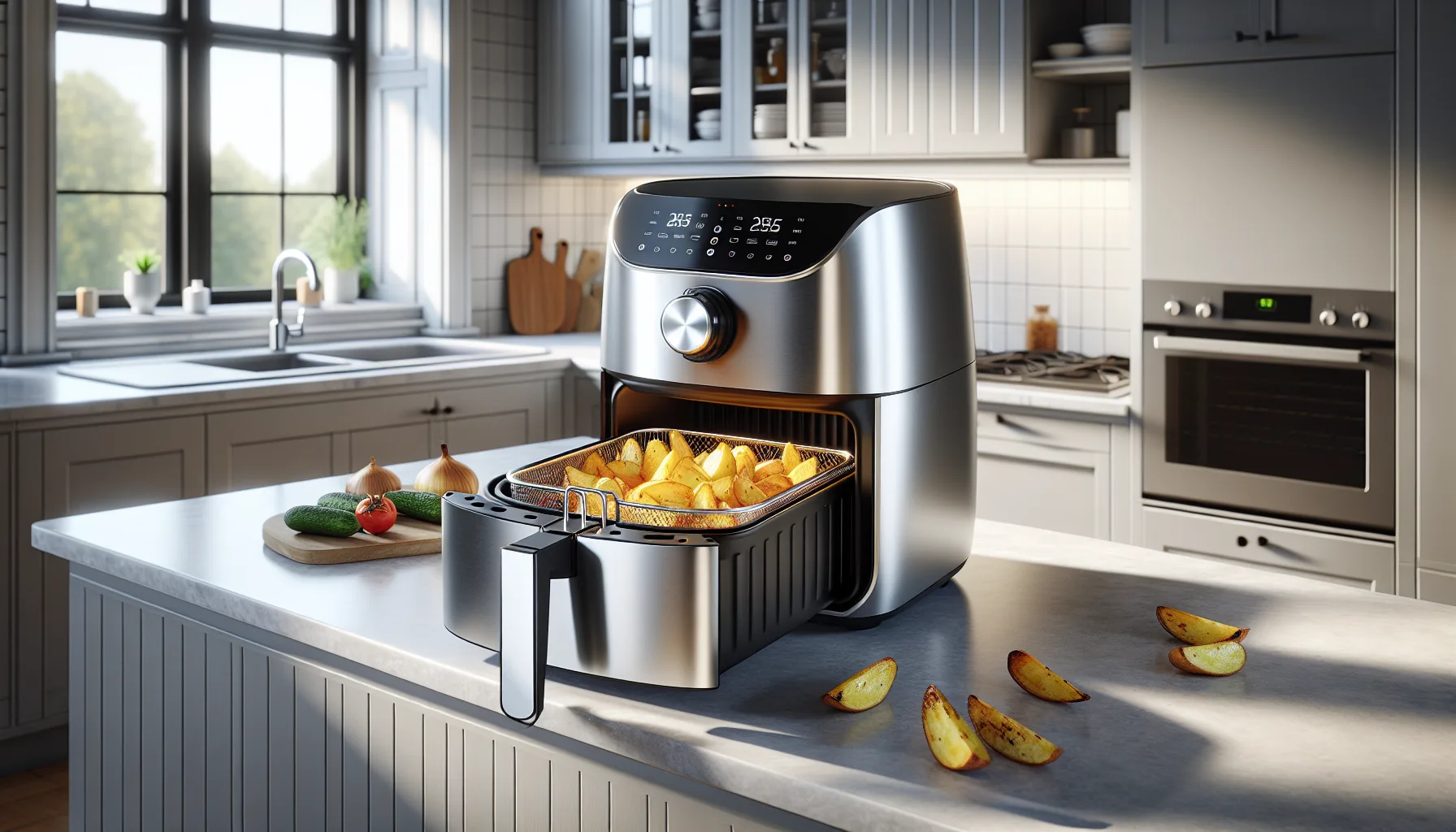
Types of Air Fryers: Which Design Suits Your Kitchen?
This is where most people get stuck, because the market has split into several distinct designs. Each has trade-offs, and the right one depends on what you actually cook.
Basket Air Fryers
The classic design and still the most popular in the UK. A pull-out drawer holds a removable basket where you place the food. They’re simple, easy to clean, and heat up fast.
- Best for: singles, couples, and small families who mostly cook one type of food at a time
- Typical capacity: 3 to 5 litres
- Price range: £40–£100
- Downsides: limited capacity, can only cook one thing at a time, basket shape means uneven results if you overcrowd it
The Ninja AF300UK (around £70 from Argos) is the one I’d point most people towards in this category. It heats evenly, the basket is dishwasher-safe, and it doesn’t take up much worktop space. For a tighter budget, the Tower T17021 (about £45 from Amazon UK) does the job, though the build quality feels cheaper and the dial controls are less precise.
Dual-Zone Air Fryers
These have two separate drawers, each with independent temperature and time controls. You can cook chips in one zone and chicken in the other, both finishing at the same time. The “sync” and “match” buttons handle the timing for you.
- Best for: families of three or more, anyone who wants a full meal from one appliance
- Typical capacity: 7 to 10 litres total (split across two zones)
- Price range: £130–£220
- Downsides: larger footprint on your worktop, heavier, more to clean
This is the category I’d recommend for most UK households. The Ninja Foodi AF400UK (around £200 from John Lewis) is the gold standard — I’ve used one daily for over a year and the sync function actually works well. The Salter EK4750 (about £130 from Argos) offers similar dual-zone functionality for less, though the cooking results aren’t quite as consistent and the drawers feel flimsier.
Oven-Style Air Fryers
These look like a mini oven with racks inside rather than baskets. They’re better for flat items like pizza, toast, and anything you’d put on a baking tray.
- Best for: people who want to replace a toaster oven, bakers, anyone who needs to see their food cooking
- Typical capacity: 10 to 30 litres
- Price range: £80–£250
- Downsides: take up significant worktop space (or need dedicated shelf space), slower to preheat than basket models, harder to clean around heating elements
The Ninja SP101UK FlexDrawer (around £230 from Currys) bridges the gap between oven-style and dual-zone. If you want a pure oven-style, the Cosori Air Fryer Toaster Oven (about £150 from Amazon UK) is solid, but be honest with yourself about kitchen space before buying one of these — they’re bulky.
Multi-Cooker Air Fryers
Some air fryers double as pressure cookers, slow cookers, or steamers. The Ninja Foodi range is the most common example. They promise to replace multiple appliances.
- Best for: people with very limited kitchen storage who want maximum versatility
- Price range: £180–£300
- Downsides: jack-of-all-trades problem — they air fry adequately and pressure cook adequately, but neither as well as a dedicated appliance. They’re also heavy and awkward to store.
My view: unless you’re genuinely short on space and don’t already own a slow cooker, buy a dedicated air fryer. Multi-cookers create more compromises than they solve.
Capacity: How Big Do You Actually Need?
Capacity is measured in litres, but the numbers are misleading. A “4-litre” basket doesn’t hold 4 litres of food — that’s the total volume of the cavity. The usable cooking space is smaller.
Here’s what works in practice:
- 1-2 people: 3–4 litres is plenty. Handles two portions of chips, a couple of chicken breasts, or enough vegetables for two
- 3-4 people: 5–8 litres, or a dual-zone model. You’ll want to cook enough for the whole family without doing two batches
- 5+ people or batch cooking: 8+ litres or a large oven-style model. At this point, consider whether your regular oven might actually be more practical
The biggest mistake I see people make is buying too small. A 3-litre basket sounds fine until you’re cooking chips for four people and have to do three separate batches, by which time the first batch has gone cold. If in doubt, go one size up.
Features That Actually Matter
Manufacturers love listing fifteen features on the box. Here’s which ones are worth paying for and which are gimmicks.
Worth paying for
- Digital temperature control — being able to set exact temperatures (not just low/medium/high) makes a real difference to results. The jump from a dial to a digital display is the single most impactful upgrade
- Dishwasher-safe basket or trays — you’ll use the air fryer more if cleanup is easy. If the basket needs hand-washing every time, it starts sitting in the cupboard
- Shake reminder or mid-cook alert — a beep halfway through to remind you to shake the basket for even cooking. Simple but useful, especially for chips
- Dual-zone sync function — on dual models, the ability to start two zones at different times so everything finishes together. Ninja does this best
Nice to have but not essential
- Preheat function — some models heat up so fast (2-3 minutes) that a dedicated preheat cycle is unnecessary, but it does improve consistency on larger units
- Keep-warm mode — useful if you’re cooking in batches, but a clean tea towel over a plate does the same job
- Non-stick coating quality — ceramic coatings last longer than standard non-stick, but even budget models are adequate for the first year or two
Skip these (gimmicks)
- WiFi connectivity and app control — you still need to put the food in and take it out. Remote monitoring of an air fryer is a solution without a problem
- Built-in recipe screens — a small screen showing basic recipes that you’ll look at once and never again. Your phone does this better
- “TurboAir” or “RapidCrisp” branding — every air fryer uses convection. Proprietary names for the same technology are marketing, not features
- Rotisserie attachments — fiddly to set up, awkward to clean, and the results rarely justify the effort. Roast a chicken on the rack instead
Power and Energy Costs
Most air fryers in the UK draw between 1,000 and 2,000 watts. The Energy Saving Trust estimates that running an air fryer for 15 minutes uses roughly 0.25-0.5 kWh, compared to about 1.5 kWh for a conventional oven over the same period.
At current UK energy prices (roughly 24p per kWh as of early 2026), that’s about 6-12p per air fryer session versus 36p for the oven. Cook with your air fryer daily and you could save £60-80 per year compared to using the oven for the same meals.
Higher wattage doesn’t always mean better cooking — it just means faster heating. A 1,800W model will reach temperature quicker than a 1,400W one, but once both are at 200°C, the results are similar. Don’t pay extra purely for higher wattage.
Noise Levels: The Thing Nobody Mentions
Every air fryer has a fan, and fans make noise. Most models produce around 55-65 decibels during operation — comparable to a loud conversation. In an open-plan kitchen-living room (which most newer UK homes have), this matters.
Basket models tend to be slightly quieter than oven-style units because they’re more enclosed. Dual-zone models with two fans can be noticeably louder. If noise is a concern, check user reviews specifically for noise comments — it’s the one thing manufacturer specs never mention.
I tested this with my Ninja AF400UK and a cheap decibel meter: it hits about 58dB on high, which is fine while the telly is on but noticeable if you’re trying to have a quiet conversation nearby. Not a dealbreaker, but worth knowing.
Worktop Space and Kitchen Fit
This is the most underrated factor in UK kitchens specifically. British kitchens are, on average, smaller than American or Australian ones. A large oven-style air fryer that reviewers love on YouTube might be designed for kitchens with double the worktop space you’ve got.
Before buying, measure your available worktop space and check the product dimensions — including clearance. Most air fryers need 10-15cm of space behind and above them for ventilation. A model that’s 35cm deep needs nearly 50cm of worktop depth once you account for that gap.
- Small kitchens (terraced houses, flats): stick to compact basket models under 4 litres, or a slim dual-zone like the Ninja AF300UK
- Medium kitchens: dual-zone models fit comfortably, and you’ve got room to leave it out permanently
- Large kitchens: any style works, but even then, do you really want a 30-litre oven-style unit taking up space when your built-in oven is right there?
Build Quality and What Lasts
At the budget end (under £60), air fryers work well for the first 6-12 months but tend to develop issues. Non-stick coatings start flaking, hinges loosen, and buttons become unresponsive. I’ve seen this firsthand with a Tower model that was brilliant for eight months and then the basket coating started peeling.
Mid-range models (£80-150) from Ninja, Cosori, and Tefal typically last 2-4 years with daily use. The build quality jump from £50 to £100 is significant — sturdier baskets, better seals, more responsive controls.
Premium models (£150+) should last 3-5 years. At this price, you’re paying for build quality, features, and brand support. Ninja’s UK customer service is responsive and they stock replacement parts, which matters when a basket handle snaps after year two.
My recommendation: if you’re unsure whether you’ll use an air fryer regularly, start with a budget basket model around £50. Use it for three months. If it becomes part of your routine (and it probably will), upgrade to a quality dual-zone unit and give the budget one to a friend.
Cleaning and Maintenance
This is what separates daily-use appliances from cupboard-dwellers. If it’s a pain to clean, you won’t use it.
- Basket models are the easiest — pull out the basket, wash it in the sink or dishwasher, wipe the interior, done
- Dual-zone models have two baskets to clean but the process is the same. Check that both baskets fit in your dishwasher before buying — some larger ones don’t
- Oven-style models are the worst for cleaning. Crumbs fall between racks, grease spatters on the interior walls, and the heating element is exposed. Budget 10 minutes for a proper wipe-down versus 2 minutes for a basket model
A tip from daily use: line the basket with perforated parchment liners (available in bulk from Amazon UK, about £8 for 100). They catch grease, prevent sticking, and mean you only need to properly scrub the basket once a week instead of after every use. If you want to see how quick typical meals are to prepare, have a look at our air fryer cooking times chart — most everyday items are done in under 20 minutes.
What to Cook First
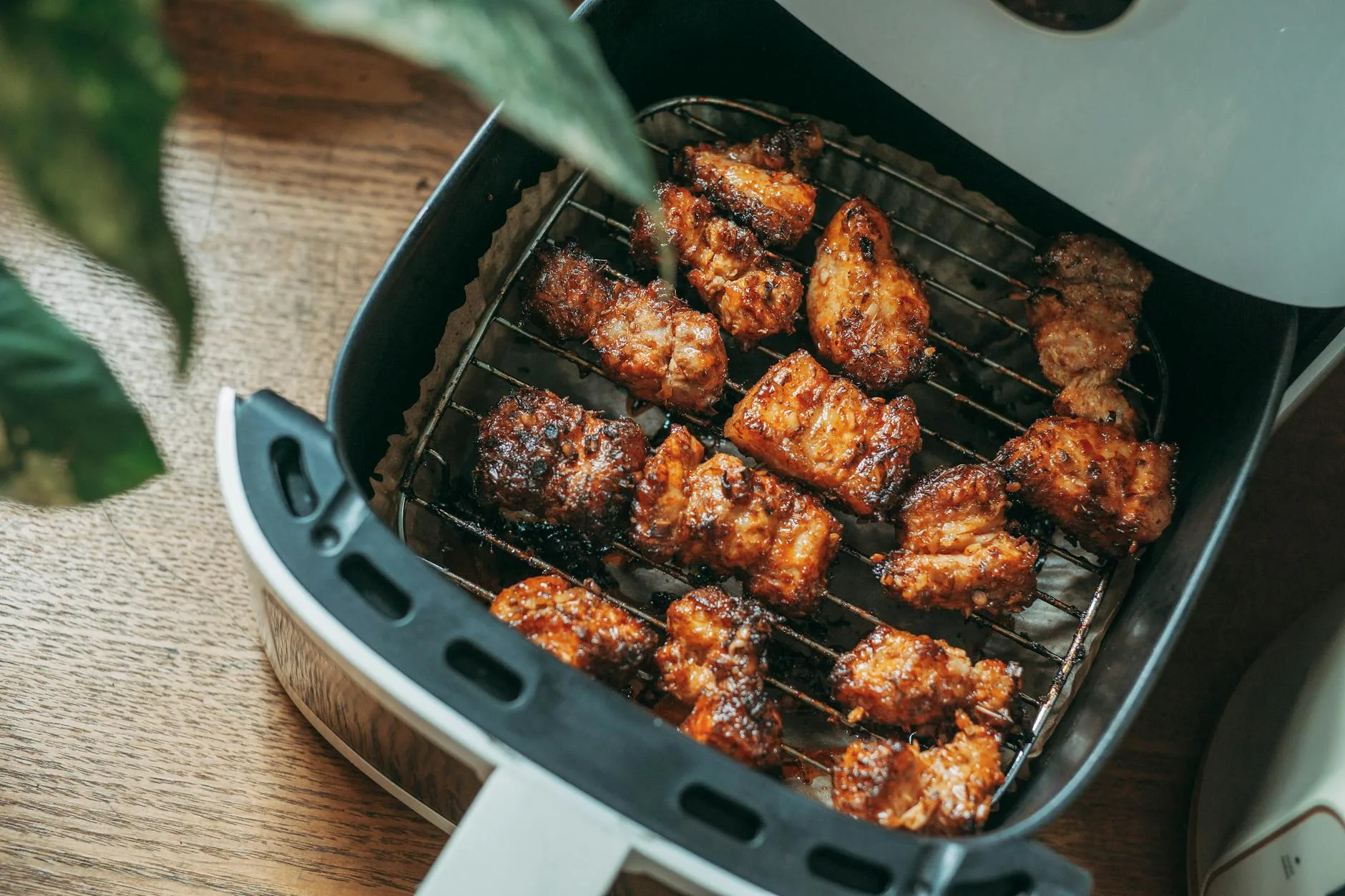
If you’re new to air frying, start simple. Frozen chips are the gateway — they come out crispier than oven-baked and take half the time. From there, try chicken thighs (skin-on, 180°C, 22 minutes — the skin goes unbelievably crispy), halloumi slices, and roasted vegetables.
Where air fryers really shine is reheating leftovers. Cold pizza from the fridge? Four minutes at 180°C and it’s better than when it arrived. Day-old roast potatoes? Crispy again in six minutes. This alone makes the appliance worth owning.
For a proper starting point with recipes and timings, our beginner-friendly air fryer recipes guide covers ten meals that work brilliantly for first-timers.
Budget Breakdown: What to Expect at Each Price Point
- Under £50 — basic basket models with dial controls. Good for testing whether you’ll use an air fryer. Tower and Salter dominate here. Expect decent cooking but cheaper build quality. The Tower Vortx T17023 (about £40 from Argos) is the pick of this range.
- £50–£100 — better basket models with digital controls, some compact dual-zone options. This is where value peaks. The Cosori Pro LE (around £80 from Amazon UK) offers premium-feeling build quality at a mid-range price.
- £100–£200 — dual-zone models from reputable brands. The Ninja Foodi AF400UK lives here and it’s the one I recommend most. You get genuine functionality gains, not just premium branding.
- £200+ — large capacity oven-style models, premium multi-cookers, and top-spec Ninja units. Worth it if you’re replacing multiple appliances or cooking for five-plus regularly. Overkill for a couple.
If you’re looking at air fryers as part of a broader kitchen kit refresh, it’s worth thinking about how your other cookware choices complement an air fryer — a good non-stick pan still handles things an air fryer can’t.
Brands Worth Trusting in the UK
- Ninja — the market leader for good reason. Build quality, innovation, and UK customer support are all strong. Their dual-zone models set the standard.
- Cosori — excellent value, particularly in the mid-range. Good digital interfaces and reliable cooking performance. Less brand recognition means lower prices for similar quality.
- Tefal — solid mid-range options backed by decades of kitchen appliance experience. The ActiFry range uses a different paddle-stirring approach that some people prefer.
- Tower — good budget options for entry-level buyers. Don’t expect them to last years, but they’re a low-risk way to try air frying.
- Salter — similar to Tower in positioning. Adequate for the price but not where you want to stay long-term.
Avoid no-name brands from marketplace sellers on Amazon. They often lack UK safety certifications, replacement parts are impossible to find, and if something goes wrong, you’ve got no recourse.
My Recommendation: The Short Version
For most UK households — a family of two to four with a standard-sized kitchen — buy a mid-range dual-zone air fryer. The Ninja Foodi AF400UK at around £200 from John Lewis or Currys is the one I’d choose. It cooks two things simultaneously, the sync function works as advertised, both baskets are dishwasher-safe, and Ninja’s UK support is decent.
If that’s too much to spend, the Cosori Pro LE single-basket at about £80 is the best value in the range. Digital controls, solid build, and it handles everything a single person or couple needs.
If you just want to try air frying without committing, grab a Tower Vortx T17023 for around £40. Use it for a month. You’ll know quickly whether it’s for you.
The air fryer you’ll get the most from is the one that fits your kitchen, matches how many people you’re feeding, and doesn’t feel like a chore to clean. Everything else — the apps, the fancy screens, the seventeen preset buttons — is noise.
Keep reading on KitchenGearUK: Best Large Air Fryers 2026: Family-Sized Options, Best Dual Zone Air Fryers 2026 UK: Cook Two Things at Once, Best Air Fryers Under £100 2026 UK, Is an Air Fryer Healthy? What the Evidence Says.
Frequently Asked Questions
What size air fryer is best for a family? For most families, a 6-8 litre air fryer or a dual-zone model gives enough space for chips, chicken and vegetables without cooking everything in tiny batches.
Is one large basket or two smaller baskets better? One large basket is better for whole chickens and big batches. Two baskets are better when you want to cook different foods at different temperatures.
What features matter most in an air fryer? Capacity, easy cleaning, reliable temperature control and a clear drawer or basket design matter more than preset programmes.
What should I check first with How to Choose the Right Air Fryers? Start with the real use case, then check size, compatibility, running costs and maintenance. A product that looks good on paper can still be the wrong fit if it does not suit the room, routine or budget.
How do I avoid wasting money on How to Choose the Right Air Fryers? Avoid buying on one headline feature alone. Compare the practical details, read the warranty or returns terms, and choose the option that solves your main problem rather than the one with the longest specification list.