Choosing a slow cooker by litres is less precise than it sounds. The number on the box describes the bowl’s total volume, not a guaranteed number of dinners, and the same capacity can feel spacious for a casserole but cramped around a whole chicken. This slow cooker size guide turns the main UK capacities into practical choices for households, joints, soups and batch cooking.
For most households of two to four people, a 3.5-litre model is the sensible starting point. Choose roughly 1.5 litres for one or two modest servings, dips or side dishes; move towards 5 litres for larger meals and medium joints; and consider 6 litres or more if you regularly feed five or more people or want several freezer portions. Bowl shape and usable fill level matter as much as the headline number.
- The quick answer
- What capacity really means
- Slow cooker sizes compared
- Household and meal type
- Batch cooking, joints and freezer portions
- Shape, fill level and footprint
- Mistakes to avoid
- Which size should you buy?
Slow Cooker Size Guide: The Quick Answer
If you want one broadly useful answer, buy a slow cooker of about 3.5 litres for a two-to-four-person household. It is large enough for an everyday stew, curry or chilli without demanding the worktop and cupboard space of a family-size machine. It is also the size at which there is a wide choice of simple manual and digital models.
Use these bands as starting points rather than promises:
- About 1.5 litres: best for one person, two light portions, sauces, dips and side dishes.
- About 3 to 3.5 litres: the most versatile range for two to four people and smaller batches.
- About 4.5 to 5 litres: useful for four substantial servings, guests, medium joints and leftovers.
- 6 litres and above: designed for bigger households, large joints and deliberate freezer cooking.
This broadly agrees with Lakeland’s beginner guidance, which positions 1.5 litres for smaller meals, 3.5 litres for family cooking and 6 litres for larger households. Treat those labels as helpful retail shorthand, not a fixed portions-per-litre formula. Appetite, recipe, bowl shape and how much liquid you add all change the result.
Our recommendation is based on usable capacity, common meal shapes and the trade-off between leftovers and storage. It is not based on pretending that every recipe or household eats the same amount.
What Slow Cooker Capacity Really Means
The stated capacity is normally the maximum volume of the cooking bowl. You should not expect to cook with liquid filled to the rim. Slow cookers need headroom, and many recipes work best when the crock is somewhere around half to three-quarters full. The appliance manual should take priority because safe fill guidance varies.
That difference between stated and working capacity explains why a 3.5-litre cooker does not necessarily hold 3.5 litres of finished stew. Meat and vegetables displace liquid, ingredients may sit above the sauce, and space is needed to stir or lift food without spilling. Conversely, ingredients often release water during slow cooking, so filling the bowl with liquid at the beginning can leave a watery result.
Litres do not equal fixed portions
A litre of thin soup can be divided neatly. A litre of chicken thighs, potatoes and carrots cannot. Four adult portions of a meat-heavy casserole may require more room than four portions of lentil soup. A whole joint also needs usable length and width, even if its volume appears suitable on paper.
This is why claims such as “one litre feeds one person” are too crude. They ignore appetites, side dishes and recipe density. Use household labels to narrow the field, then check the bowl dimensions and the largest foods you plan to cook.
Stated capacity versus usable capacity
Two models described as 3.5 litres may have different practical space. A tall, narrow crock can hold plenty of soup but may not take a wide joint. A lower oval bowl can be easier for chicken, brisket or layered vegetables. Thick ceramic walls and a curved base also influence the internal dimensions.
A current Crock-Pot 3.5-litre model, for example, is marketed for three to four people. That is a useful model-specific reference, but it should not be turned into a universal rule for every 3.5-litre cooker or every family.
Slow Cooker Sizes Compared
The table below shows the most useful way to think about capacity: what each band does comfortably, and where it starts to become restrictive.
| Stated capacity | Best suited to | Typical uses | Main limitation |
|---|---|---|---|
| 1 to 1.5L | One person or side dishes | Small stews, dips, sauces, porridge | Little room for leftovers or bulky ingredients |
| 3 to 3.5L | Two to four people | Curries, chilli, casseroles, smaller batches | Can be tight for wide joints or generous batch cooking |
| 4.5 to 5L | Three to five people | Family meals, medium joints, planned leftovers | More worktop and cupboard space |
| 6 to 6.5L | Five or more people | Large joints, entertaining, freezer batches | Can be unnecessarily large for small meals |
| 7L+ | Very large households or high-volume prep | Big batches and bulky cuts | Heavy bowl, large footprint and more food needed to fill well |
Compact slow cookers: around 1 to 1.5 litres
A compact model makes sense when storage is limited and the cooker will genuinely be used for small quantities. It can suit a person living alone who does not want repeated leftovers, a couple making a side dish, or anyone wanting a second crock for sauces and dips.
The compromise is flexibility. One extra guest, a bulky pack of vegetables or a desire to freeze two portions can exceed the comfortable working volume. Small does not automatically mean quicker, either: slow cooking times are recipe- and appliance-dependent.
Everyday slow cookers: around 3 to 3.5 litres
This is the balanced option. It handles familiar meals for a couple with leftovers or a small family, while remaining manageable to lift, wash and store. It is the range we would check first unless you already know that whole joints or high-volume batch cooking are priorities.
It also fits naturally alongside a practical one-pot cooking routine: enough room to build a complete meal, without turning every dinner into a week’s worth of food.
Family slow cookers: around 4.5 to 5 litres
Moving to 5 litres creates useful headroom. There is space for larger cuts, more vegetables and leftovers, yet the appliance is not at the extreme end of the category. It is often the better fit for four hungry adults, a family that wants lunch the next day, or a couple that batch cooks intentionally.
Large slow cookers: 6 litres and above
A 6-litre cooker earns its space when it is regularly filled with large family meals, a whole chicken or multiple freezer portions. It is less convincing as insurance against the occasional guest. A large removable crock is heavier, takes more washing-up space and may encourage quantities you do not actually want.
Very large 7-litre-plus models are specialist rather than automatically better. Check that you can store the base and lift the wet ceramic bowl safely.
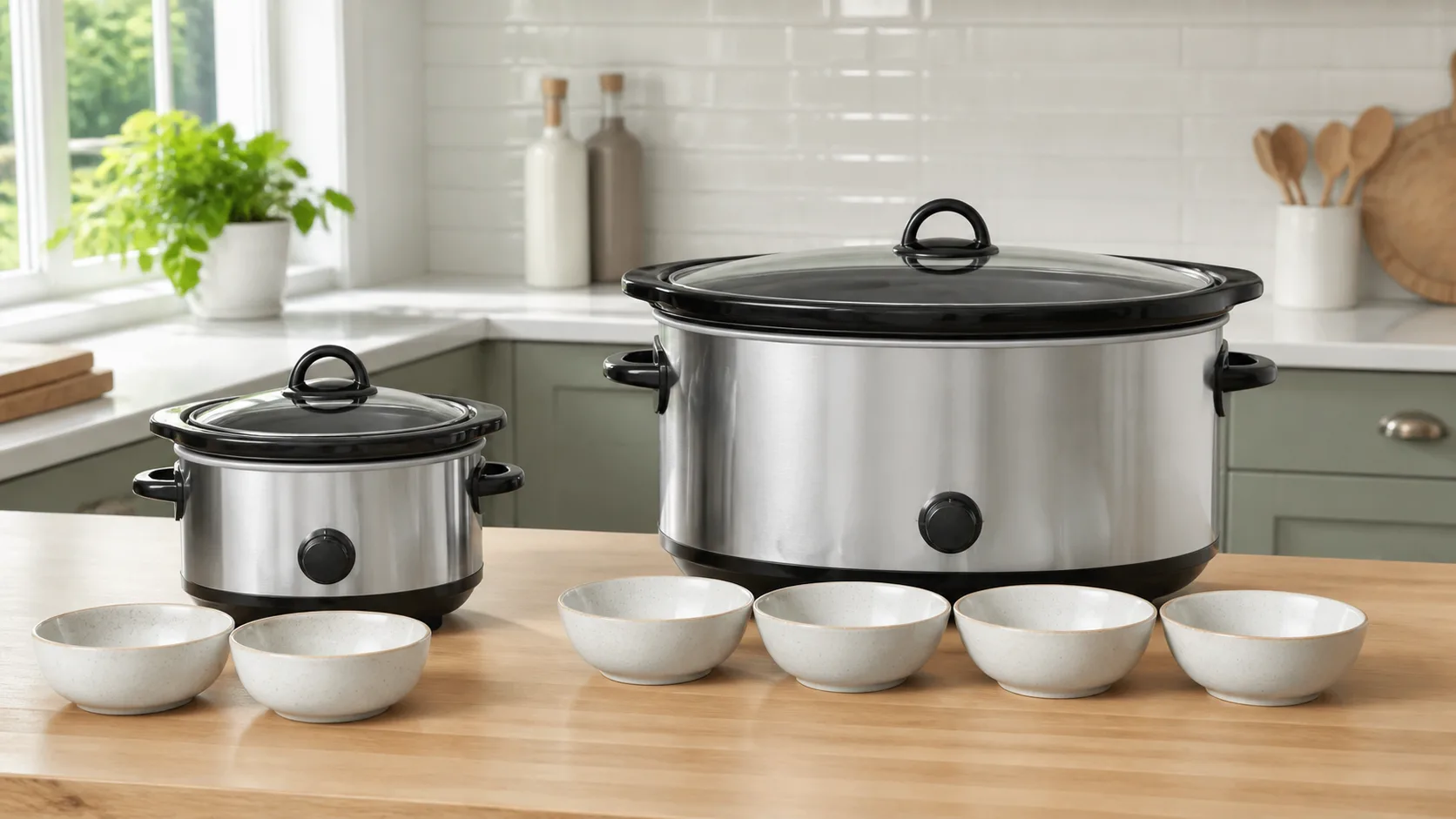
Match Size to Household and Meal Type
Household size is the obvious starting point, but cooking behaviour is the better final test. Two people who cook once and freeze four portions need more capacity than four people preparing a modest sauce to serve with rice.
One person
Choose 1 to 1.5 litres if you want one or two modest servings and minimal storage impact. Choose about 3.5 litres if you prefer to cook once and refrigerate or freeze the remainder. The larger model is not wasteful if the extra food has a plan; it is wasteful if leftovers repeatedly go unused.
Two people
A 3 to 3.5-litre cooker is usually the safest choice. It gives more flexibility than a mini model, can make dinner plus lunch, and still works for recipes scaled to a couple. A 1.5-litre model remains valid for smaller appetites or a very tight kitchen.
Three or four people
Start at 3.5 litres for ordinary stews, curries and chilli. Move towards 4.5 or 5 litres if portions are generous, teenagers are involved, or leftovers are part of the plan. For a family of four, a cramped cooker is more frustrating than a little unused headroom.
Five or more people
Look at 6 litres and above, then check dimensions rather than relying on the badge alone. If meals include side dishes, a 5-litre model may still be sufficient; if the slow cooker must provide the whole meal and seconds, 6 to 6.5 litres is more reassuring.
Meal type changes the answer too. Soup settles efficiently into a round crock. Lasagne-style layers, racks of ribs and whole poultry favour width or an oval bowl. Beans and pulses expand, while leafy vegetables collapse. Choose for the bulkiest regular meal, not the neatest recipe in your rotation.
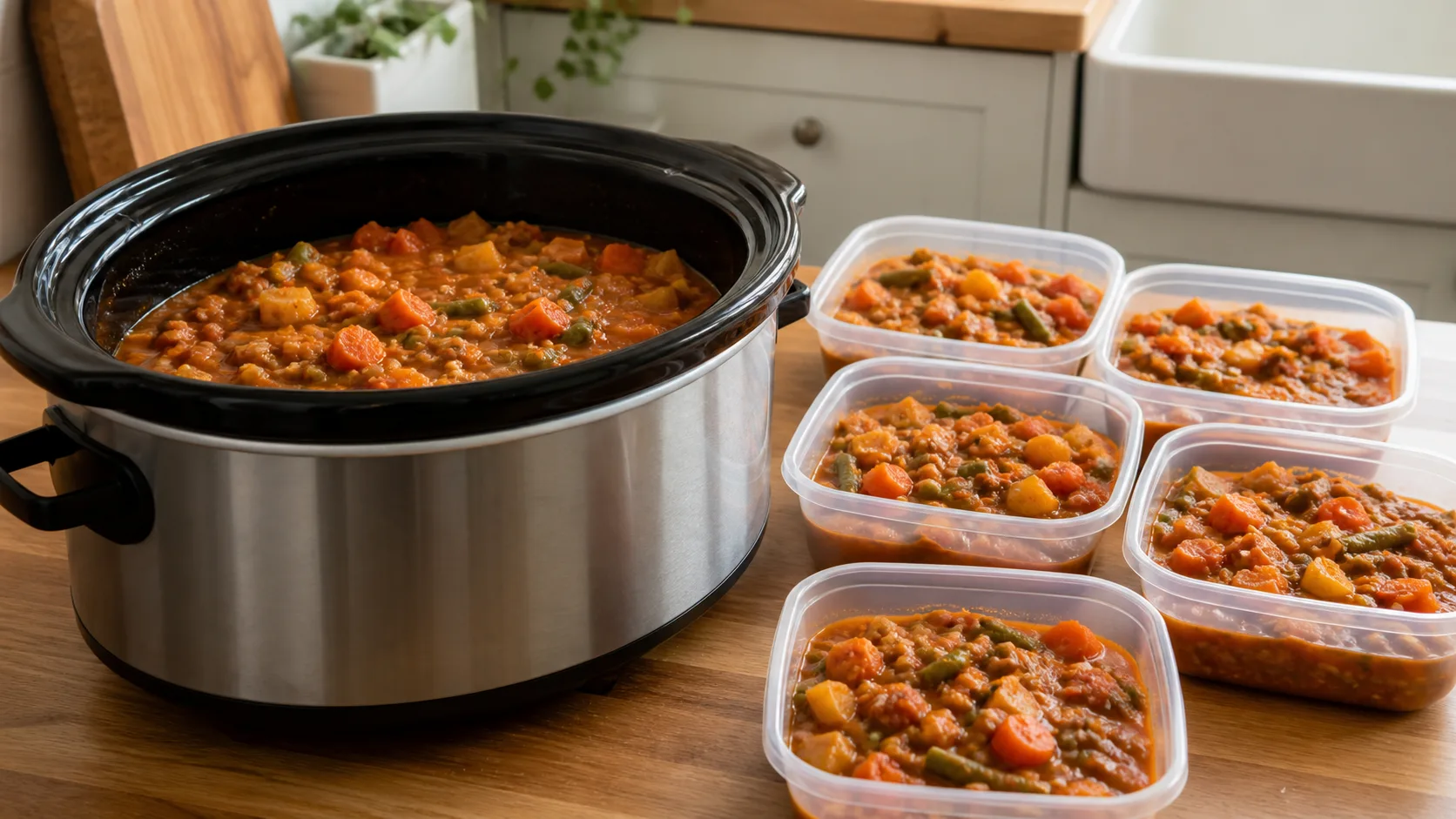
Batch Cooking, Joints and Freezer Portions
Batch cooking is the strongest reason to size up. A couple may be well served by 5 or 6 litres if each cook produces dinner plus several labelled freezer portions. The appliance is then doing a deliberate job rather than merely occupying extra space.
Before buying, decide what “batch” means in your kitchen:
- Dinner plus lunch tomorrow usually needs only modest extra capacity.
- Dinner plus two freezer meals points towards roughly 4.5 to 5 litres.
- A full week’s base sauce, chilli or stew can justify 6 litres or more.
- Several different small recipes are often better cooked separately than combined in one oversized machine.
Our batch cooking and freezing guide covers cooling, portioning and labelling. Those steps matter because extra capacity only saves time when the cooked food is handled and used properly. A stack of suitable containers should be part of the plan; see the broader meal-prep equipment guide for the supporting kit.
Choosing for joints and whole chickens
Do not choose a cooker for a joint by litres alone. Measure the food you buy most often and compare it with the bowl’s internal length, width and depth. An oval 5-litre crock may accept a shape that will not sit properly in a taller round model of similar capacity.
There should be room for vegetables and cooking liquid without forcing the lid upwards. The lid must seat correctly. If roast-style joints are your main priority, a heavy casserole may sometimes be a more flexible tool; our guide to the best cast-iron casserole options explains that alternative.
Freezer portions need a purpose
Count the portions you will actually freeze, not the maximum number you could create. Labelled two-person packs are useful for couples; single portions can be more flexible for mixed schedules. Leave appropriate expansion space in containers and follow current food-safety guidance for cooling and reheating.
Shape, Fill Level and Kitchen Footprint
Capacity comparisons can hide four practical differences.
Round versus oval bowls
Round bowls are efficient for soups, beans, sauces and compact storage. Oval bowls generally make more sense for whole poultry, long joints and layered dishes. Neither is universally better. Match the shape to the ingredient that is hardest to fit.
Minimum and maximum fill
Buying a huge crock “just in case” can leave routine meals below the appliance’s recommended fill range. Buying too small creates the opposite problem: ingredients are packed tightly and liquid or expanding foods approach the lid. Check the manual for the specific model rather than copying a single rule from the internet.
External footprint
A 6-litre label describes the bowl, not the space used by handles, control housing and lid. Measure the worktop location, including clearance from walls and cupboards, and check the full external dimensions. If the cooker will be stored between uses, measure the shelf height with the lid in place.
Weight and cleaning
Large ceramic bowls are heavy before food or water is added. Make sure the route from cooker to sink is comfortable and the bowl fits in the sink. Dishwasher-safe does not help if the crock consumes the whole lower rack. Multi-cookers with a metal inner pot can be lighter, but their shape and working capacity may differ from a traditional crock.
These ownership details are part of our editorial judgement. A theoretical extra litre is not an upgrade if it makes the appliance awkward enough that you stop using it.
Mistakes to Avoid When Choosing a Size
Assuming the household label is a guarantee
“Serves four” is a useful retail description, not a measured promise. Check the model’s dimensions, recommended fill and example recipes. Consider whether the cooker supplies the entire meal or a component served with rice, bread or vegetables.
Buying for the largest imaginable occasion
The slow cooker should fit normal life. If you feed eight people once a year but cook for two every week, a very large model may be the wrong compromise. Borrowing a second cooker or using another pan for rare occasions can be more sensible.
Ignoring leftovers
Leftovers are either a benefit or a burden. Size up when you enjoy planned lunches and freezer meals. Stay smaller when food is likely to be forgotten. This is a better decision rule than household headcount alone.
Comparing only litres and price
At the time of writing, compact manual slow cookers commonly sit around £20 to £35, mid-size models around £35 to £70, and larger or more sophisticated digital models can run from roughly £50 beyond £100. Promotions at retailers such as Argos, Currys, John Lewis and Lakeland move those bands. Do not pay more merely for volume; pay for the capacity, controls and bowl design you will use.
Confusing slow cookers with multi-cookers
A multi-cooker may list a similar pot volume while needing different headroom for pressure cooking or other modes. Compare the usable capacity for slow cooking specifically. Extra functions are valuable only if they replace another appliance or suit how you cook.
Which Slow Cooker Size Should You Buy?
For most people choosing their first slow cooker, our verdict is 3 to 3.5 litres. It is the least risky balance of useful portions, manageable footprint and everyday flexibility for a household of two to four.
Choose differently when your routine gives you a clear reason:
- Choose 1 to 1.5L for one person, two light servings, side dishes or a genuinely tiny kitchen.
- Choose 3 to 3.5L for a couple wanting leftovers or a small family’s normal meals.
- Choose 4.5 to 5L for generous family servings, medium joints or regular planned leftovers.
- Choose 6 to 6.5L for five-plus people, large joints or several freezer portions per cook.
- Choose 7L+ only when you routinely prepare very large quantities and can handle the footprint and bowl weight.
Once you know the right band, compare actual products in our best slow cookers UK guide. Start with capacity, confirm the bowl shape and dimensions, then decide whether a timer, keep-warm mode or multi-cooker functions are worth paying for. That order prevents a long feature list from distracting you from the one requirement the appliance cannot fix later: physical size.
Frequently Asked Questions
Frequently Asked Questions
What size slow cooker is best for two people?
A 3 to 3.5-litre slow cooker is the most flexible choice for two people because it can make dinner plus leftovers. A 1.5-litre model can work if portions are modest, storage is tight and you rarely batch cook.
Is a 3.5-litre slow cooker big enough for a family of four?
It can be for ordinary stews, curries and chilli, especially when served with sides. Choose around 4.5 to 5 litres if portions are generous, you want leftovers or you regularly cook bulky ingredients.
How many people does a 6-litre slow cooker feed?
It is commonly suited to about five or more people, but there is no guaranteed number. Recipe density, appetite, side dishes and safe fill guidance all affect portions. It is also useful for smaller households doing deliberate batch cooking.
Can a slow cooker be too big?
Yes. Routine recipes may sit below the model’s recommended fill level, and the larger appliance and ceramic bowl take more room and are heavier to clean. Buy for regular cooking, not the biggest gathering you can imagine.
What size slow cooker do I need for a whole chicken?
The chicken must fit inside with the lid fully seated, so internal length, width and bowl shape matter more than litres alone. An oval cooker around 4.5 to 6 litres is often the relevant range, but measure your usual bird and check the model dimensions.
Should I size up for batch cooking?
Yes, if you have a clear plan for the extra portions. Moving from 3.5 litres towards 5 or 6 litres can provide useful freezer meals, but only when you have containers, freezer space and a routine for cooling, labelling and using them.