Choosing between a 20cm, 24cm, 28cm and 30cm frying pan is mostly a question of usable cooking surface, not the number of people printed on a box. A pan that is too small crowds food and steams it; one that is too large can overhang the hob zone, feel clumsy and occupy half a cupboard. This frying pan size guide matches the common UK diameters to real meals, hob zones and storage.
For most homes, 28cm is the best single frying-pan size. It has room for two steaks, three or four eggs, pancakes and a family quantity of vegetables without becoming as awkward as a 30cm pan. Choose 20cm for one egg or a compact second pan, 24cm for one or two people, and 30cm when you regularly cook broad batches and your hob, arm strength and cupboard can support it.
In This Article
- The quick answer
- What frying pan diameter measures
- 20cm, 24cm, 28cm and 30cm compared
- Match size to food and portions
- Match the pan to your hob zone
- Weight, oven fit and cupboard space
- When two pans are better than one
- Which size should you buy?
- Frequently asked questions
Frying Pan Size Guide: The Quick Answer
The four common sizes are not simply small, medium, large and extra-large. Each has a job it does well.
- 20cm: one egg, a small omelette, a single burger, nuts or a compact side dish.
- 24cm: two eggs, a one-person main meal, two modest portions or smaller pancakes.
- 28cm: the all-rounder for two to four people, two steaks, several eggs, family vegetables and most pancakes.
- 30cm: larger batches, broad fillets, four generous portions or food that needs plenty of space to brown.
Those are useful starting points, not guaranteed serving counts. A 28cm pan with steep, nearly vertical sides can have more flat cooking area than another 28cm pan with a wide flared rim. Food shape matters too: four chopped chicken thighs fit differently from four whole fish fillets.
Our recommendation comes from comparing the geometry manufacturers publish with the space common foods need in a single layer. That is more reliable than assigning a fixed number of people to every diameter. If you want one safe answer, buy 28cm. If you cook mostly for yourself and dislike bulky cookware, 24cm is the more disciplined choice.
What Frying Pan Diameter Actually Measures
The quoted diameter is normally measured across the top rim, from one inside edge to the opposite edge. It does not usually describe the flat base that touches the hob or the level area where food sits.
Rim diameter versus cooking surface
Most frying pans slope outwards. On a 28cm pan, the flat cooking surface might be several centimetres narrower than the rim. The exact loss depends on the side angle, base construction and curve between the base and wall. Two pans labelled 28cm can therefore hold noticeably different quantities in one layer.
This is the measurement check we use when assessing a pan for a particular task:
- Top diameter: useful for lids, storage and comparing the overall footprint.
- Flat interior diameter: the important figure for steaks, fish, pancakes and browning.
- Base diameter: the contact area that should match the hob zone, especially on induction.
- Wall height and flare: determine how safely you can toss vegetables or contain a sauce.
Manufacturer ranges show why the labels are still useful. The current Tefal Easy Cook & Clean range, for example, includes several familiar pan diameters. It demonstrates that 20cm, 24cm and 28cm are established buying sizes, but it does not make every pan of those diameters identical.
Measure the pan you already like
Before replacing a pan, measure its top rim and then the flat interior. Note whether it feels roomy or cramped for your usual meal. That two-minute check is more valuable than a generic household chart because it anchors the new purchase to something you have actually cooked with.
If a retailer lists only the top diameter, look at the product photographs and side profile. A sharply flared pan sacrifices more flat area than a straight-sided sauté-style pan. For a deeper explanation of how construction affects cooking, see our cast iron, non-stick and stainless-steel cookware comparison.
20cm, 24cm, 28cm and 30cm Pans Compared
This comparison assumes an ordinary frying pan with sloping sides. Treat the portion column as a practical range rather than a promise.
| Pan size | Best for | Typical capacity | Main compromise |
|---|---|---|---|
| 20cm | Single items and side dishes | 1 egg, small omelette, 1 burger | Too cramped for most complete meals |
| 24cm | One person or two light portions | 2 eggs, 1 steak, small pancake | Limited browning space for batches |
| 28cm | General household cooking | 2 steaks, 3–4 eggs, family vegetables | Can feel large on a compact hob |
| 30cm | Large batches and broad ingredients | 4 portions, large fillets, batch sautéing | Heavy, harder to store and needs a large zone |
20cm: useful, but rarely your only pan
A 20cm pan is excellent for a fried egg that stays compact, toasting spices, melting butter or cooking a single burger. It heats quickly and is easy to wash. In a small kitchen it can also double as a serving pan for a hot side dish.
Its weakness appears as soon as ingredients need separation. Two eggs can merge at the edges, vegetables pile up rather than brown, and a standard steak may leave little room for turning. Buy 20cm as a deliberate small pan, not because it is the cheapest entry in a range.
24cm: the compact everyday choice
A 24cm pan suits one person well and can serve two when the main ingredient is modest or accompanied by other dishes. It is comfortable for two eggs, a chicken breast, a small omelette or a pancake that is easy to flip. It also fits the smaller zones found on many UK hobs.
For a couple who cooks one main pan of food, 24cm can become restrictive. Crowding causes moisture to collect, so mushrooms, mince and diced meat lose the dry surface contact needed for good browning. If that is your normal cooking, move up to 28cm.
28cm: the best all-rounder
This is the diameter we would choose for one main frying pan. It balances food space with manageable weight and fits the largest zone on most standard four-zone hobs. There is enough room to keep two steaks apart, spread vegetables into a shallower layer or make a full-width pancake without the pan becoming specialist equipment.
Our judgement is based on normal household tasks rather than a product ranking: 28cm resolves crowding more often than 24cm, while avoiding much of the handling and storage penalty of 30cm. Readers choosing a specific model can move from this guide to our best non-stick frying pans UK buying guide.
30cm: valuable when the space is intentional
A 30cm pan gives broad ingredients room to lie flat. It works for larger fish fillets, several burgers, family portions of vegetables or batches where evaporation matters. The extra two centimetres over a 28cm pan sound minor, but the surface-area increase is meaningful because area grows across the whole circle.
The trade-off is equally real. A fully loaded 30cm pan is heavier to lift, may overhang the largest hob ring and can be awkward in a standard sink. Check the base diameter, handle length and cupboard depth before buying one.
Match Pan Size to Food and Portions
Pan choice is easier when you start with the food rather than the household number. The aim is usually to keep the main ingredients in one layer with enough room to turn them.
Eggs and omelettes
Use 20cm for one fried egg or a compact two-egg omelette. A 24cm pan gives two eggs breathing room and makes a broader omelette. For three or four fried eggs, 28cm is safer because the whites can spread without climbing over one another.
A large pan is not automatically better for omelettes. In a 30cm pan, a small egg mixture becomes thin and can cook before the filling is ready. Match the diameter to the amount of egg, not the number of diners.
Steaks, burgers and fish
One average steak or burger fits a 24cm pan; two are more comfortable in 28cm. If pieces touch, the cold, damp surfaces reduce browning and make turning awkward. A 30cm pan earns its keep for three or four smaller burgers, broad fish portions or a batch of chicken pieces.
Long food exposes the weakness of diameter-only buying. A fish fillet may need usable length across the flat base even when its total area is modest. Check the interior, not just the rim.
Pancakes and flatbreads
A 24cm pan makes a controllable everyday pancake. A 28cm pan creates a more generous one and offers space for a spatula. A 30cm pan is useful for large crêpe-style pancakes, but the pan must heat evenly across its base or the centre and edges will colour at different rates.
Low sides help a spatula reach underneath. If pancakes are a priority, a dedicated shallow crêpe pan can be more useful than choosing the largest general frying pan.
Vegetables, mince and stir-frying
These foods punish an undersized pan. Mushrooms, courgettes and mince release moisture; when piled deeply, they simmer in it. A 28cm pan is a practical minimum for a family batch, while 30cm helps when you want strong evaporation and have a suitably large burner.
For regular high-volume tossing, pan depth and handle balance matter alongside width. A wok may suit the technique better; our best wok guide explains that separate choice.
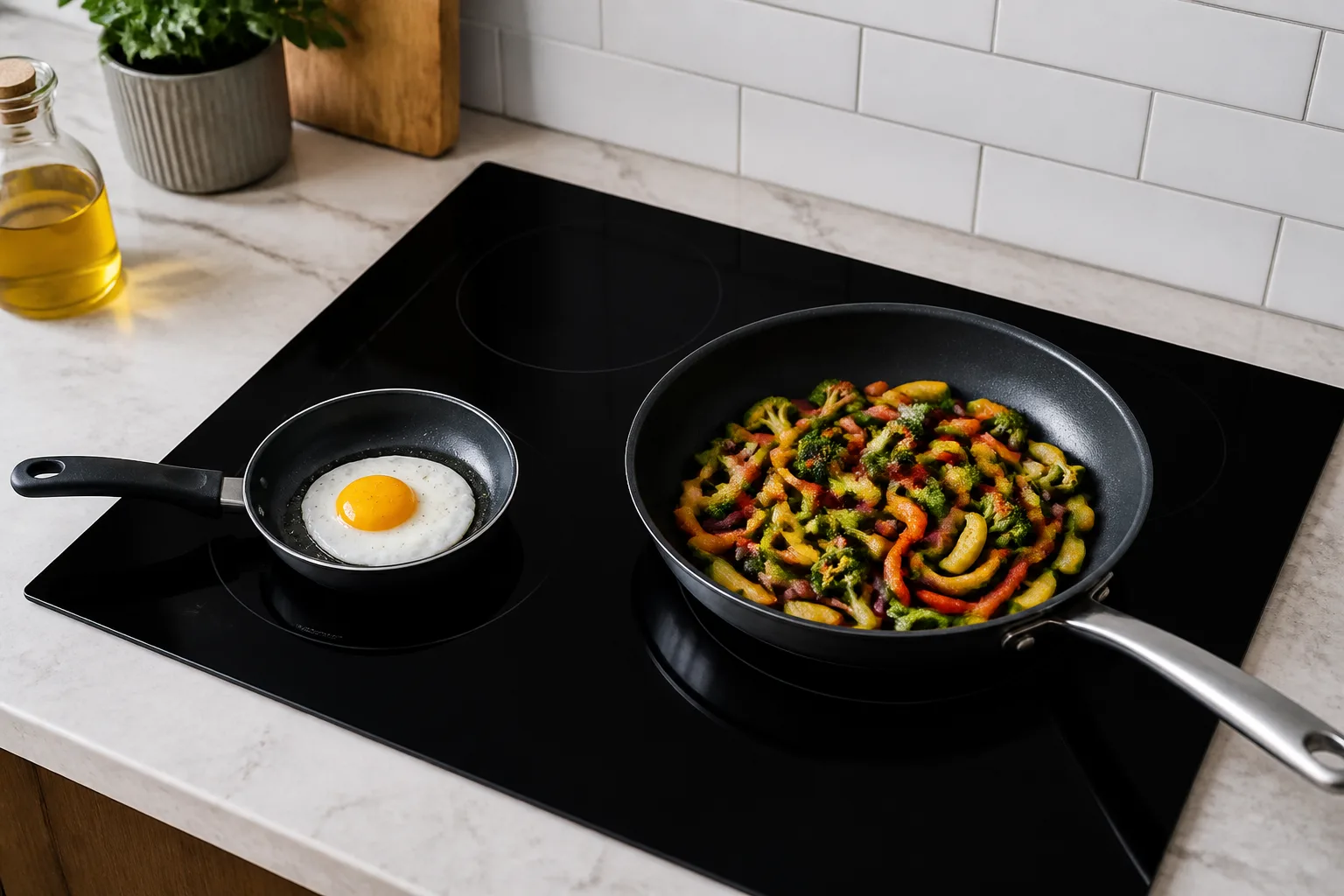
Match the Pan to Your Hob Zone
The pan must suit the heat source as well as the food. A wide rim does not compensate for a base that sits poorly on the active zone.
Induction hobs
Induction heats compatible magnetic material in the pan base. The pan needs the correct material and a base diameter the zone can detect. A 30cm rim may sit over a base that is smaller, so use the manufacturer’s base specification where available.
Our induction-compatible cookware guide covers the magnet check and labelling in detail. For sizing, the practical rule is simpler: keep the pan base close to the marked zone and avoid assuming the top diameter is the contact diameter.
Gas hobs
Gas is more forgiving of pan shape, but flames should remain under the base. Flames licking around the sides waste heat, can damage handles or coatings and create a hot outer wall. Centre a 20cm or 24cm pan on a smaller burner; reserve the largest burner for 28cm or 30cm cookware.
Solid plate and ceramic electric hobs
These surfaces transfer heat through contact, so a flat base and sensible diameter match matter. A pan that extends far beyond the element can heat slowly at the edge. A small pan on a large glowing zone wastes energy and may expose its handle area to excess heat.
If you are choosing both hob and cookware, our comparison of induction, gas and electric hobs sets out the wider trade-offs.
Weight, Oven Fit and Cupboard Space
The jump from 24cm to 30cm affects more than the food area. The pan contains more metal, the handle must control greater leverage and a family portion adds considerable weight.
Check the loaded weight
Lift the empty display model with one hand and imagine it holding food and oil. If the wrist already feels strained, the pan will be unpleasant to tip or carry when full. Cast iron makes this particularly obvious, but thick multi-layer stainless steel can also be heavy.
A helper handle is valuable on a broad, weighty pan. It turns draining, moving and oven transfer into a two-handed job rather than a test of grip strength.
Measure the oven, sink and cupboard
If the pan is oven-safe, the rim may fit while the long handle hits the door or side wall. Measure the full length, not just the diameter. Removable handles solve that problem on some systems and reduce cupboard clutter.
Tefal’s current 24cm and 28cm removable-handle set documentation is a useful example of how two pans can stack compactly. It illustrates the storage concept rather than proving that one brand or handle system is right for everyone.
Also check the sink. A 30cm pan that cannot lie flat is harder to soak and wash without splashing. In a narrow base cupboard, large pans may force handles sideways and block the door.
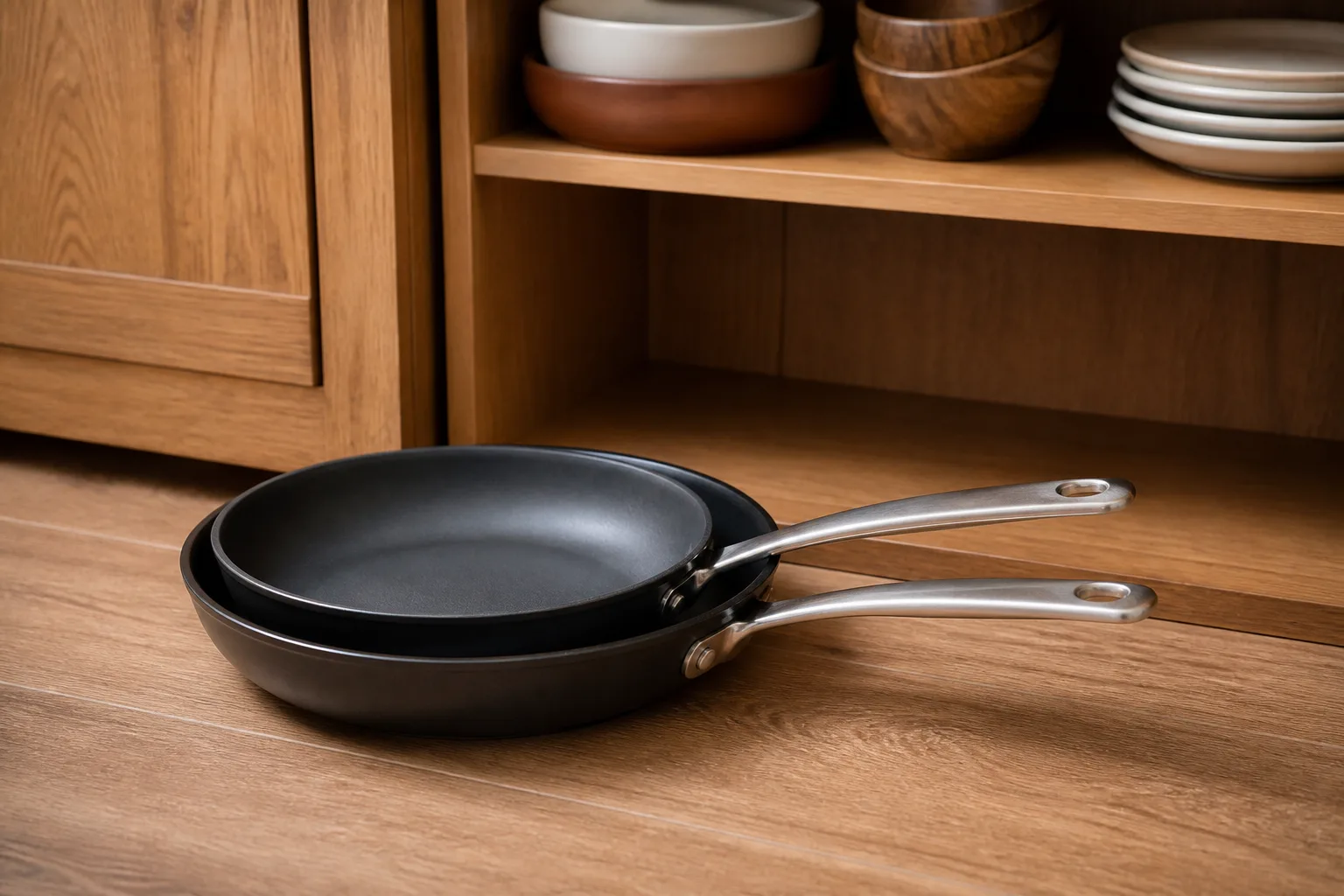
When Two Frying Pans Are Better Than One
One 28cm pan covers the widest range, but a two-pan set can remove repeated compromises. The best pairing depends on how many people you feed.
20cm plus 28cm
This is the most versatile combination for many homes. The 20cm handles one egg, toasted spices or a sauce while the 28cm cooks the main food. The size gap is large enough for each pan to have a distinct role, and they can occupy different hob zones without competing for space.
24cm plus 30cm
Choose this pair when you alternate between one-person meals and large batches. The 24cm is not so tiny that it becomes a novelty, while the 30cm provides the broad surface you deliberately need. The downside is cupboard width and total weight.
Avoid near-duplicate sizes unless the set stacks well
A 26cm and 28cm pan often feel too similar unless you regularly cook two components at once. If storage is limited, bigger spacing between sizes gives better value. A removable-handle stack can make two close sizes more defensible because the set occupies less room.
Whatever pair you choose, protect the cooking surfaces. Pan protectors or soft cloths stop stacked bases rubbing coatings; our guide to making non-stick pans last longer covers utensils, heat and cleaning.
Which Frying Pan Size Should You Buy?
Choose 28cm if you want one pan and have a standard four-zone hob. It is the strongest compromise for everyday UK cooking: large enough to prevent crowding in common meals, but usually manageable in a sink, oven and cupboard.
Use this final decision guide:
- Cooking for one: choose 24cm as the main pan; add 20cm only if you often cook single eggs or sides.
- Cooking for two: choose 28cm if you cook complete meals in one pan, or 24cm for lighter portions.
- Cooking for three or four: start with 28cm; move to 30cm when browning batches is a regular need.
- Batch cooking: choose 30cm only after checking base-to-zone fit, loaded weight and storage.
- Compact kitchen: favour 24cm or a stackable 20cm-plus-28cm set with removable handles.
The most common mistake is buying by household count alone. Measure the flat cooking area of a pan you know, check the largest hob zone and picture the foods that need to lie separately. That gives a better answer than a serving badge—and usually points back to 28cm.
Frequently Asked Questions
Is a 28cm frying pan too big for one person? Not necessarily. It is useful when one person batch cooks, browns vegetables or wants room for two components. Choose 24cm if meals are consistently small and storage matters more than batch capacity.
What size frying pan is best for two people? A 28cm pan is the safest all-round choice for two people because it avoids crowding and leaves room for complete meals. A 24cm pan can work for lighter portions or one main ingredient.
How many eggs fit in a 24cm frying pan? Two fried eggs usually fit comfortably, but side slope and flat cooking diameter affect the result. A 28cm pan is better for three or four eggs.
Will a 30cm frying pan fit a standard hob? The rim may fit, but the base should align reasonably with the largest zone. Check the base diameter and full handle length, particularly for induction and ceramic hobs.
Is frying pan size measured across the top or bottom? The advertised diameter is normally measured across the top rim. The flat cooking surface and hob-contact base are usually smaller, so check those dimensions where the retailer provides them.
Should I buy a 24cm and 28cm frying pan set? It can work, especially if both pans are used at once and stack neatly. For more distinct jobs, a 20cm-plus-28cm or 24cm-plus-30cm pair often gives a clearer difference.